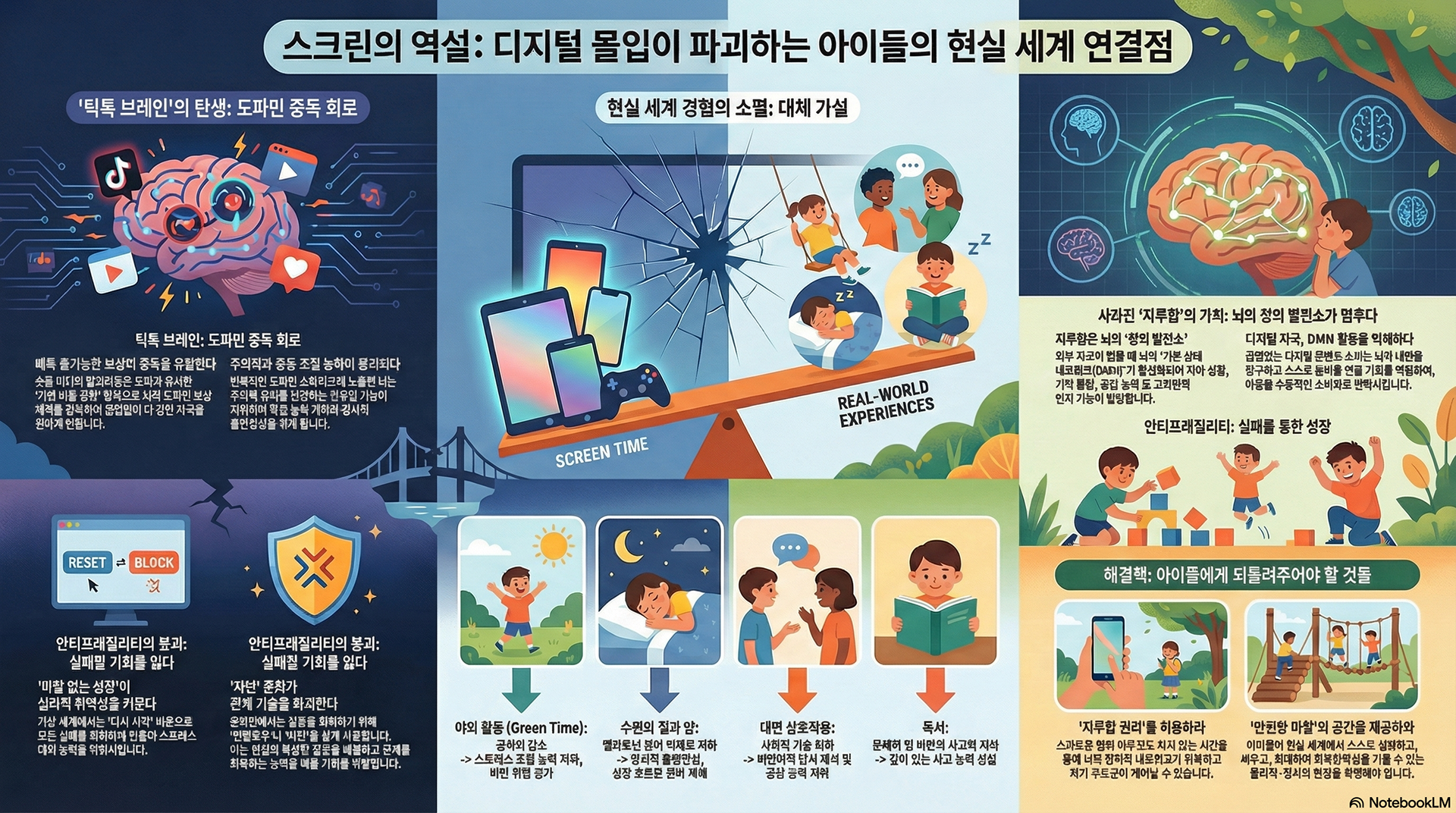
Chapter 4. The Screen Paradox: Real-World Connections Destroyed by Digital Immersion
I. The Loss of Boredom and the Silence of the Default Mode Network (DMN)
1.1. The Disappearance of Gaps: 'Boredom' as the Source of Creativity
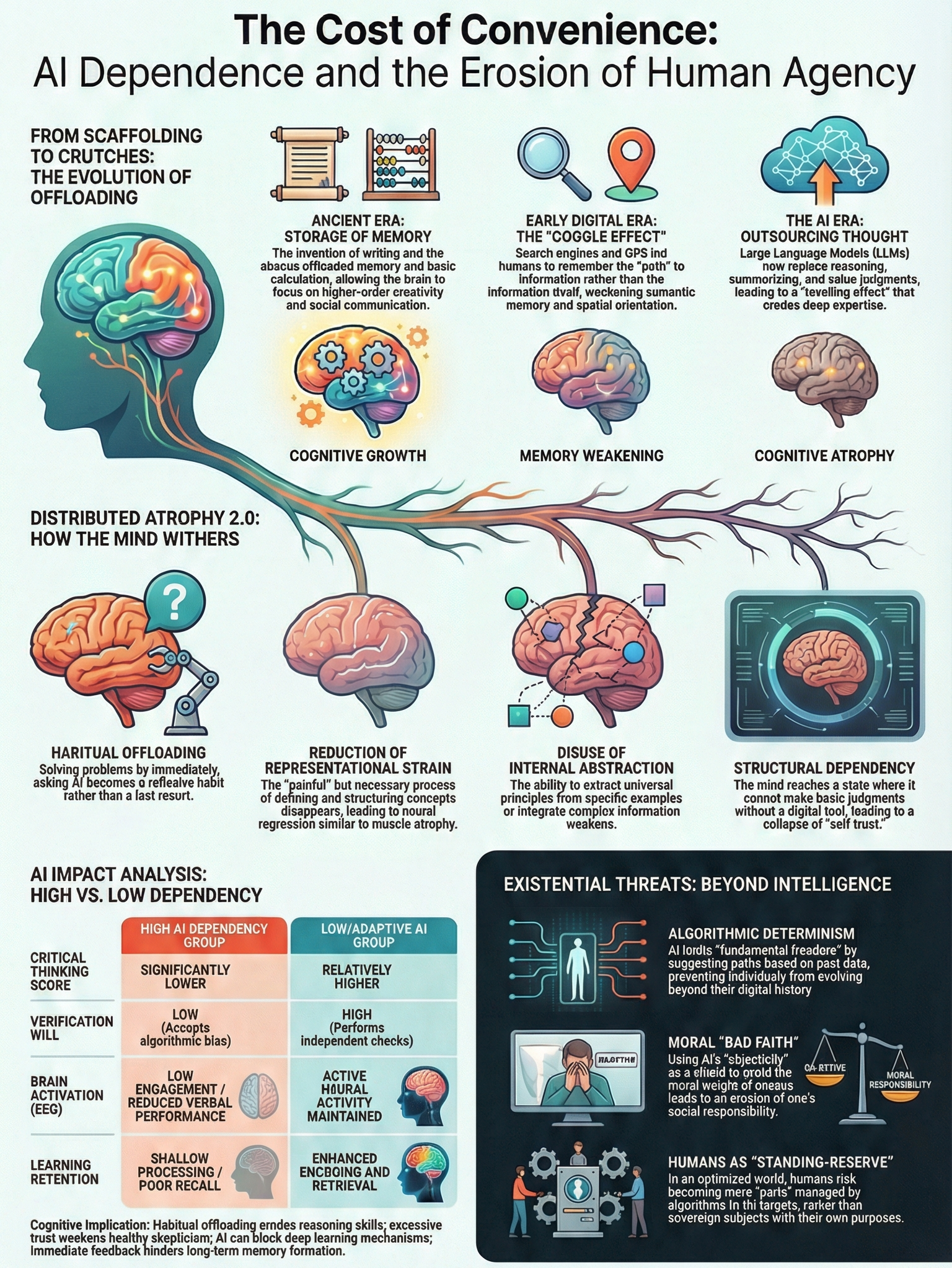
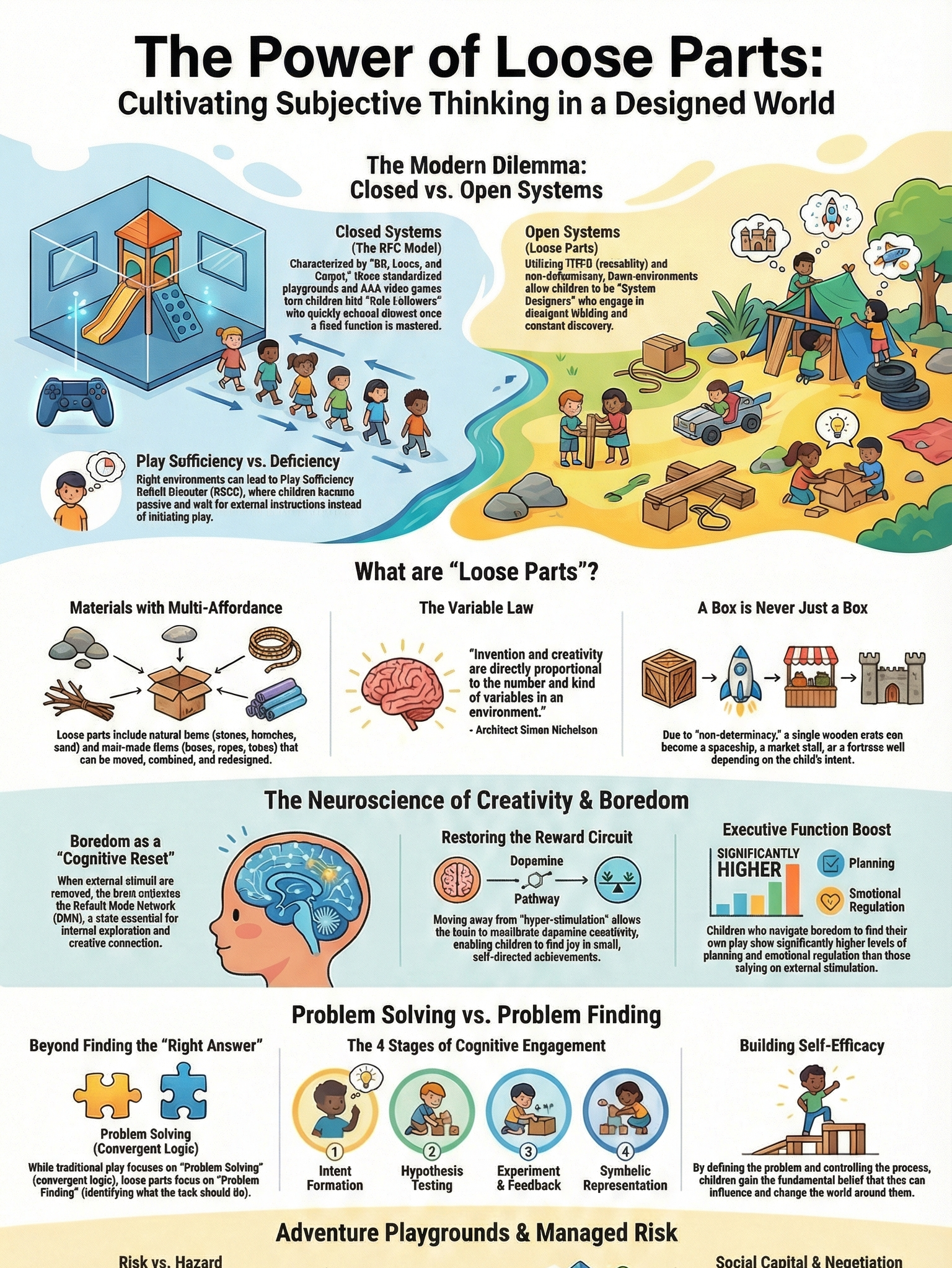
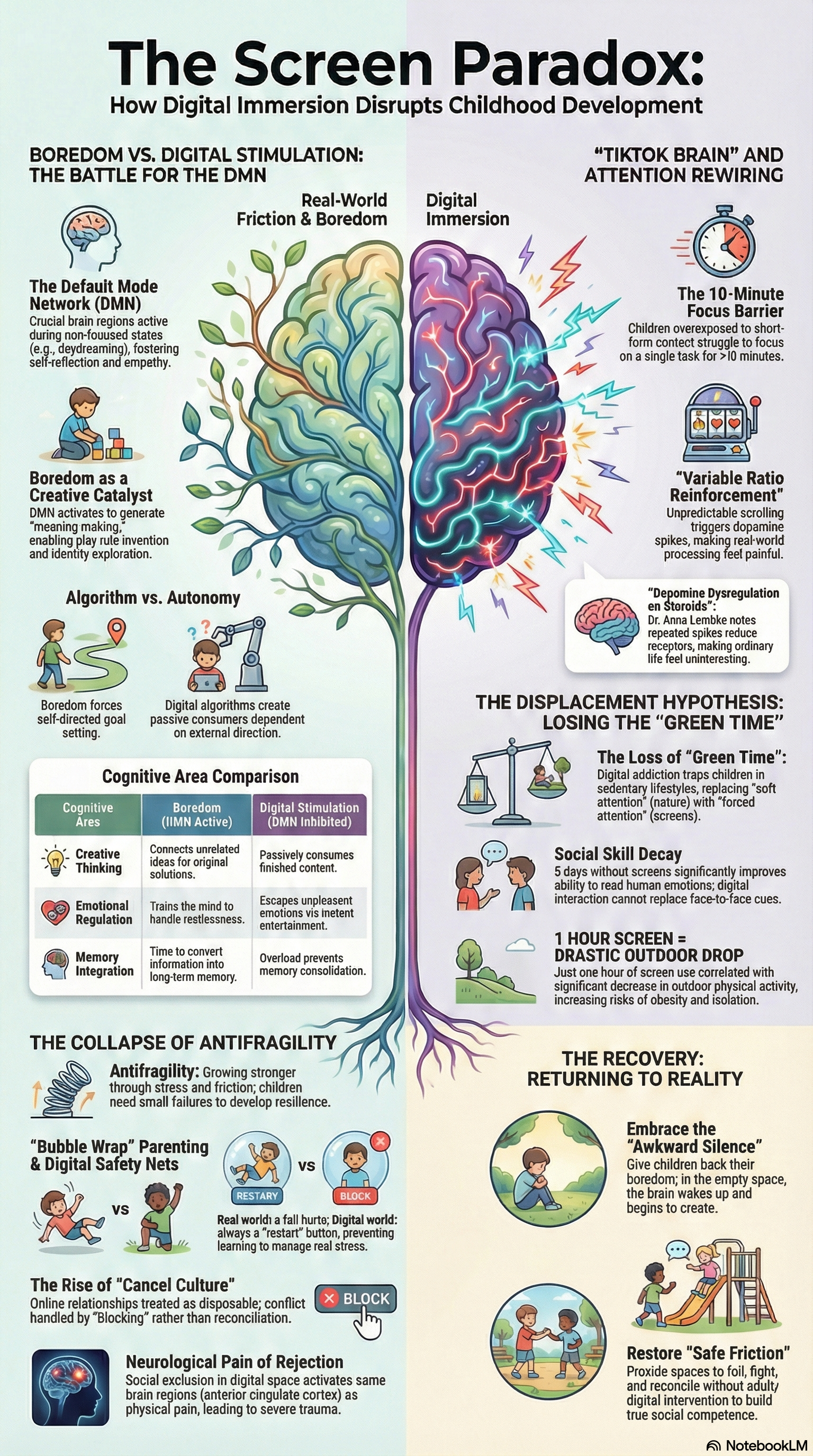
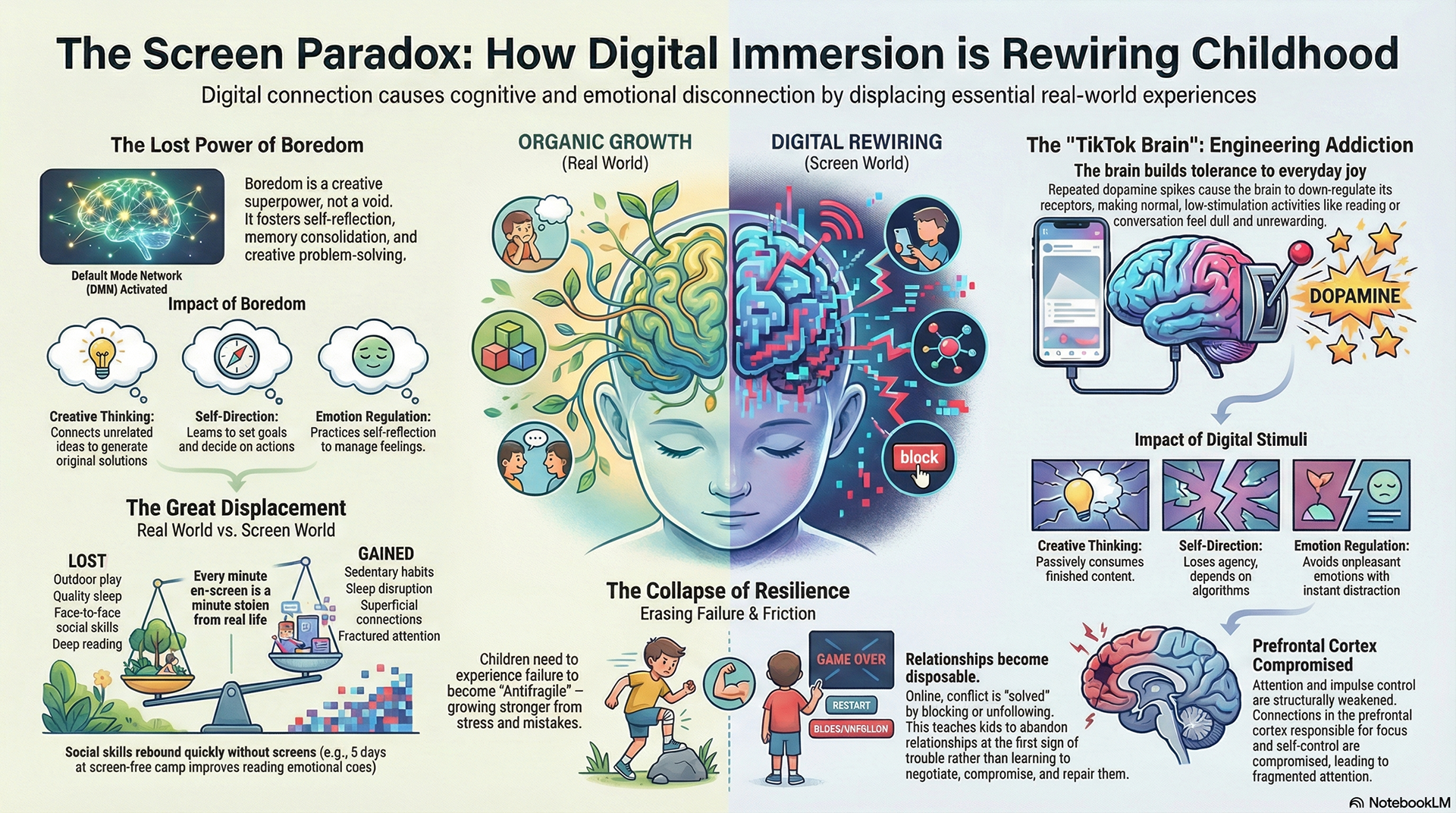
throughout human history, child development has occurred through direct interaction with the physical environment and the inevitable "empty time" between those interactions—namely, boredom. For children in the past, boredom was not something to be avoided, but a powerful catalyst that compelled them to explore their inner worlds and self-generate play. However, 21st-century digital technology, particularly the proliferation of short-form content, has completely removed these "gaps" from children's daily lives. Immediate digital stimuli relentlessly drive the child's brain, destroying the "power to endure boredom," which is the very foundation of patience and creativity.
1.2. The Brain's Breathing Space: The Function of the Default Mode Network (DMN)
Neuroscientifically, boredom is a highly active state in which the brain disengages from external stimuli and begins internal exploration. At this time, the brain's "Default Mode Network (DMN)" is activated. This is a "meaning-making network" closely linked to self-reflection, the integration of memory, and the empathy required to understand others' intentions.
When a child stares blankly at clouds or gets lost in daydreams, the DMN is actively working to form identity. However, constant screen exposure suppresses the operation of the DMN, fundamentally blocking opportunities for children to integrate experiences into long-term memory and reflect on "who I am."
II. The Dopamine Loop and the Rewiring of Attention: 'TikTok Brain'
2.1. Supernormal Stimuli and Variable Ratio Reinforcement
The fundamental reason modern children cannot tolerate boredom lies in the "Supernormal Stimuli" provided by smartphones. Short-form platforms like TikTok use "Variable Ratio Reinforcement"—exploiting the uncertainty of not knowing what the next video will be—to induce an addictiveness similar to gambling. The brain, exposed to these repetitive dopamine spikes, reduces its dopamine receptors to maintain homeostasis. Consequently, children fall into a state of "tolerance" where they find no interest in ordinary joys such as reading or walking.
2.2. Cognitive Fragmentation and the Crisis of the Prefrontal Cortex
The so-called "TikTok Brain" phenomenon fragments a child's attention. Neuroimaging studies show that long-term consumption of short-form content weakens the connectivity of the prefrontal cortex, which is responsible for impulse control and attention. A brain adapted to rapid screen transitions perceives the slow information processing of the real world as "pain," leading directly to a decline in learning abilities, such as the inability to read long passages or giving up on complex problem-solving.
III. The Displacement Hypothesis: Where Did the Real Playground Go?
3.1. The Extinction of 'Green Time' and Physical Atrophy
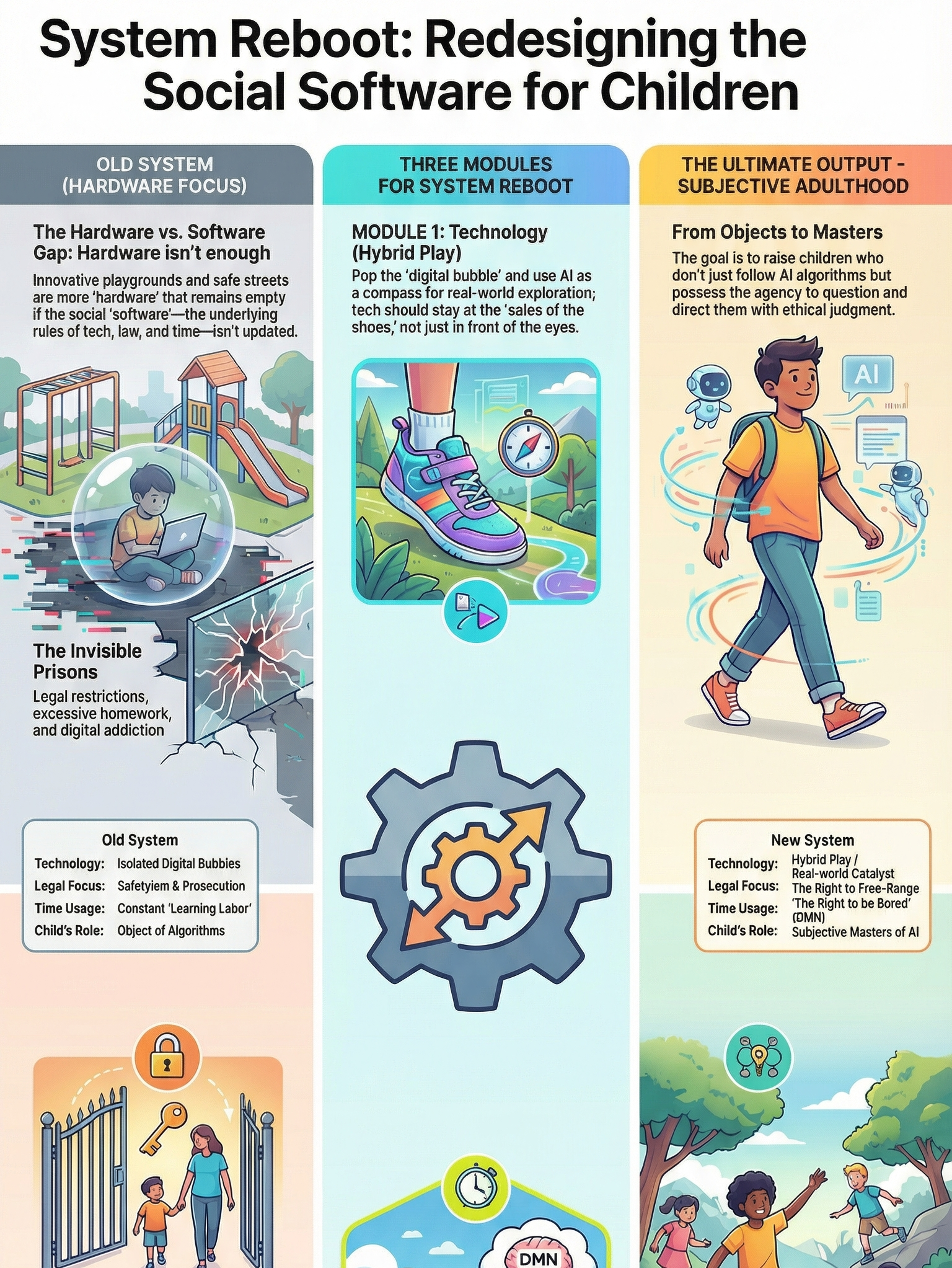
The Displacement Hypothesis warns that digital activities are physically pushing out activities essential for child development. In particular, "Green Time"—activity in nature—provides "soft attention" that relieves brain fatigue, but the increase in screen time has drastically reduced this. The absence of outdoor activity becomes a key factor deepening social isolation and depressive symptoms, as well as causing delays in gross motor development and obesity.
3.2. Unstructured Play and the Regression of Social Skills
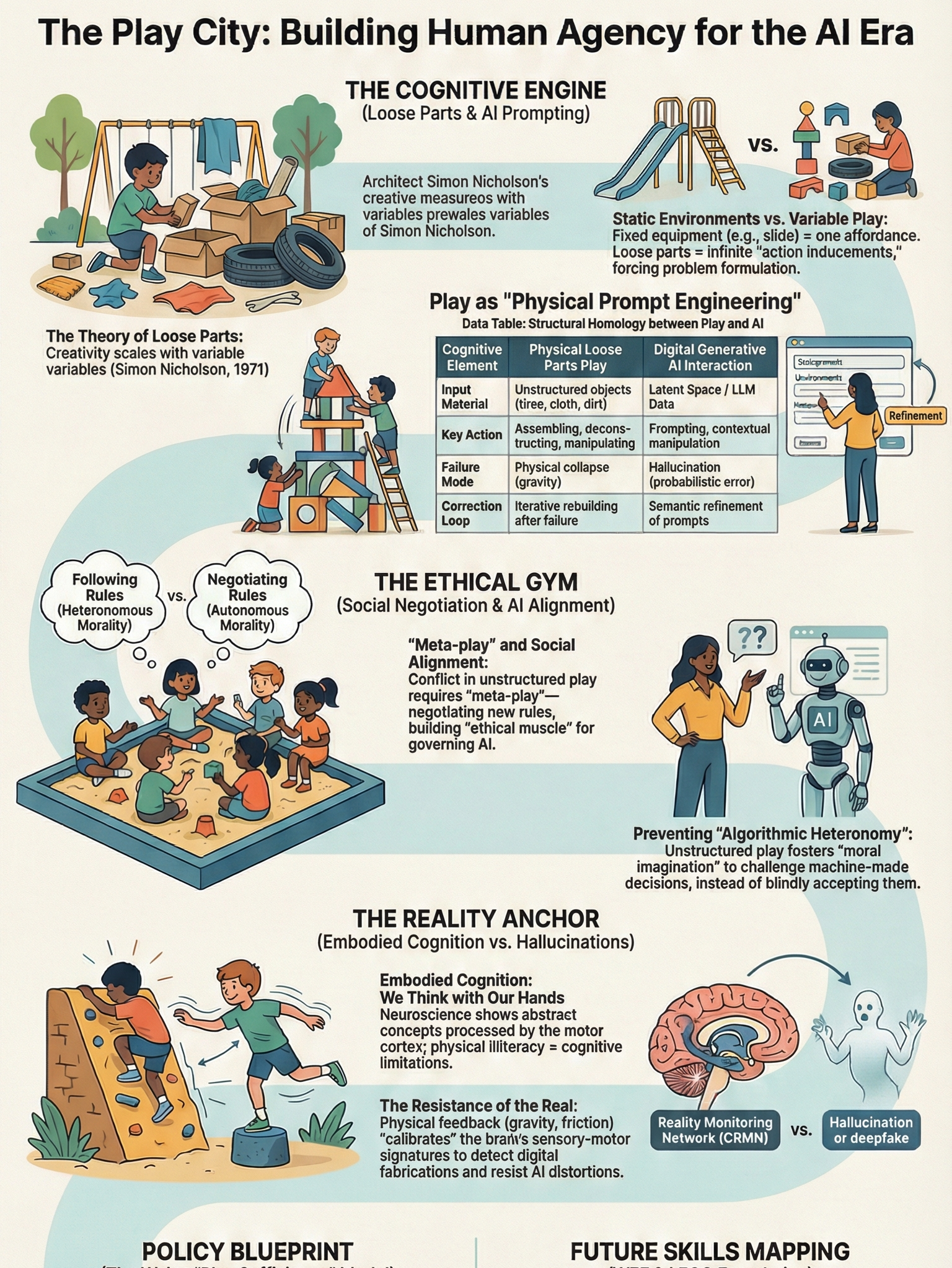
"Unstructured Play" in forests or alleys is a melting pot where children create their own rules, negotiate, and cultivate sociality. In contrast, digital games provide only pre-programmed rules and rewards. According to a study by UCLA, children who lived without screens for just five days showed a dramatic improvement in their ability to read emotions, proving that screens can never replace the rich non-verbal communication cues of reality.
IV. The Cost of a Frictionless Life: The Collapse of Antifragility and Isolation
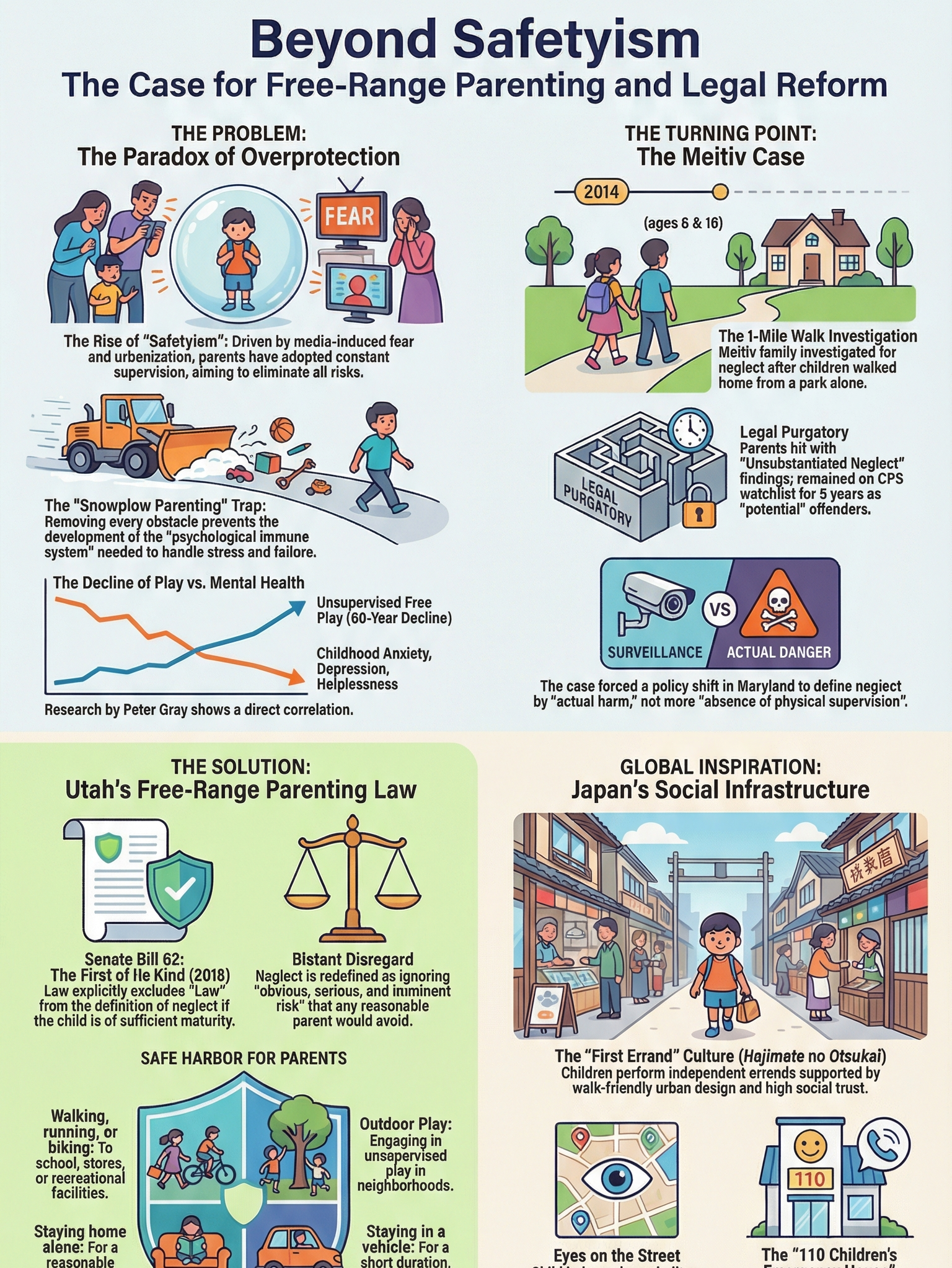
4.1. 'Bubble Wrap' Culture and the Deprivation of the Right to Fail
The digital environment is a "Frictionless" world where a "restart" button always exists. The opportunity for "Antifragility"—building resilience by falling down and facing conflict in reality—is eliminated in the digital world. Children who have not experienced failure and rejection develop a psychological vulnerability that crumbles easily under minor stress, leading to a lack of resilience in adulthood.
4.2. Cancel Culture and the Disposability of Relationships
Social media's "Blocking" function makes the complex social skill of conflict resolution unnecessary. Children accustomed to resolving conflicts by "severing relationships" rather than through dialogue in reality come to perceive human relationships as disposable services. Furthermore, online "Cancel Culture" instills an excessive fear of mistakes, causing children to focus on a "performative life" conscious of others' gazes rather than taking on challenges.
4.3. Conclusion: Restoring the 'Right to Be Bored' for True Connection
Chapter 4 emphasizes that what children have lost is not merely time, but the "right to grow humanly." Digital technology has gifted us fake connections with thousands of people, but in exchange, it has taken away the brain's creative network (DMN) and emotional resilience.
The only way to overcome this paradox is to return the "Right to Be Bored" to children. In the uncomfortable void faced when putting down the smartphone, children's brains reawaken. It is only in the dusty playground of reality, through conflicting and reconciling, that they will finally build the true "muscles of life."
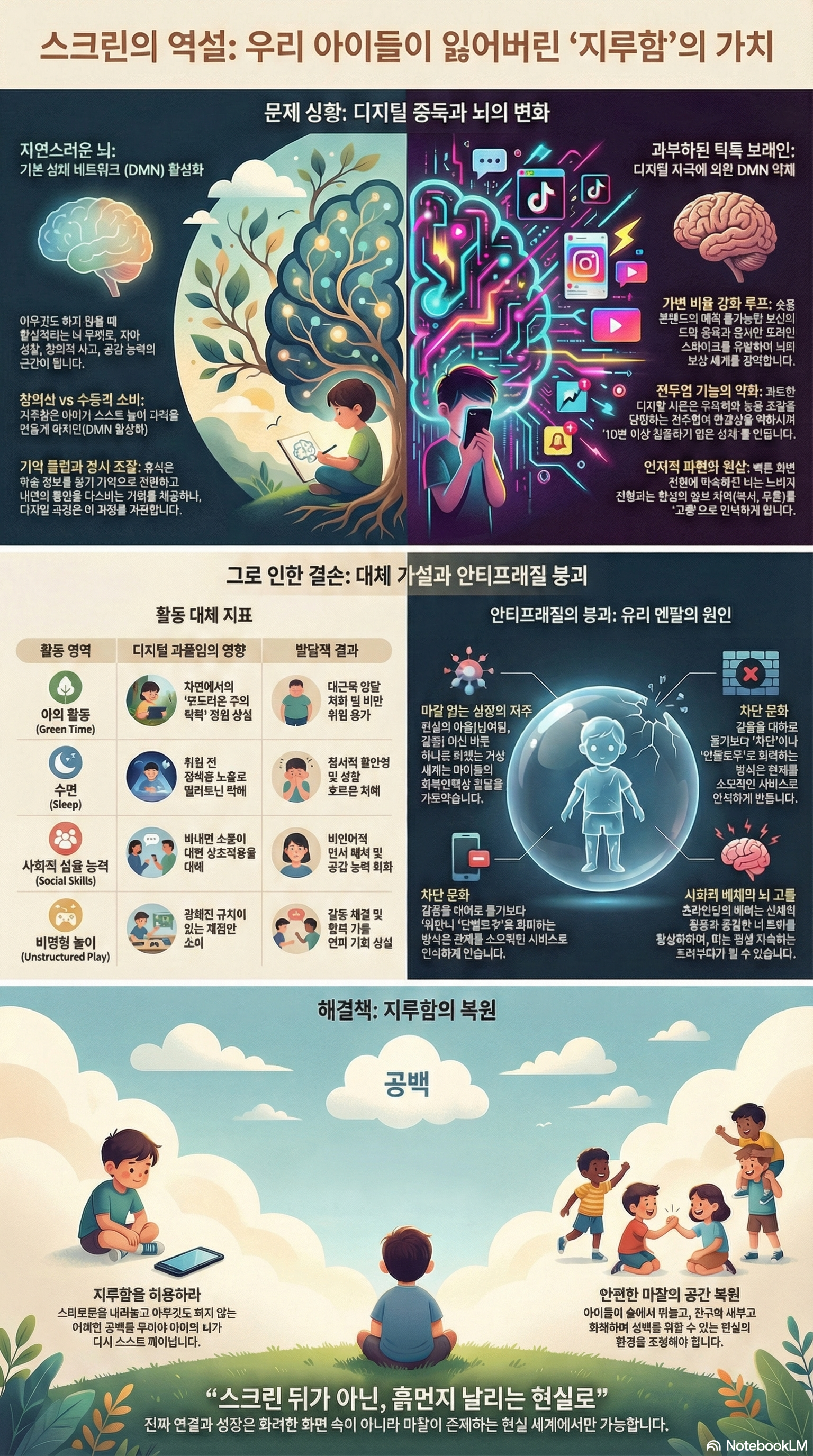
제4장. 스크린의 역설: 도파민에 절여진 뇌와 사라진 빈틈
1. 지루함의 재발견: 뇌가 숨 쉬는 시간, '공백'
인류 역사상 아동의 성장을 이끌어온 가장 위대한 스승은 역설적이게도 '지루함'이었다. 과거의 아이들에게 심심함은 회피해야 할 고통이 아니라, 내면세계를 탐험하고 창의적인 놀이를 스스로 만들어내는 강력한 촉매제였다. 하늘의 구름을 보며 공상에 잠기고, 숲에서 나뭇가지 하나로 새로운 규칙을 만드는 그 지루한 시간 동안, 아동의 뇌는 정서적 근육을 단련하고 자기 주도적인 정체성을 형성해 왔다.
그러나 21세기 디지털 문명은 아이들의 일상에서 이 필수적인 '빈틈'을 완벽하게 제거해 버렸다. 스마트폰과 결합된 숏폼 콘텐츠는 1초의 지루함도 허용하지 않는다. 아이들의 뇌는 이제 스스로 생각할 틈 없이, 외부에서 주입되는 초강력 자극에만 반응하도록 재배선(Rewiring)되고 있다.
2. '멍 때리기'의 과학: 기본 상태 네트워크(DMN)와 창의성
우리가 흔히 '멍 때린다'고 표현하는 순간, 뇌는 사실 가장 바쁘게 움직인다. 신경과학에서는 이를 **'기본 상태 네트워크(Default Mode Network, DMN)'**의 활성화라고 부른다.
DMN은 뇌가 외부 과제에서 벗어나 쉴 때 작동하는 '의미 제작 네트워크(Meaning-making Network)'다. 이 시스템이 켜져야 뇌는 비로소 파편화된 기억을 통합하고, 자아를 성찰하며, 타인의 의도를 파악하는 공감 능력을 발휘한다. 하버드 메디컬 스쿨의 연구가 입증하듯, 외부 자극이 없는 휴식 시간은 인지 자원을 회복하고 학습 능력을 다지는 필수 과정이다.
하지만 디지털 기기는 이 DMN의 스위치를 강제로 끈다. 끊임없이 쏟아지는 시청각 정보는 뇌가 정보를 '소화'하고 '응고'할 시간을 주지 않는다. 그 결과, 아이들은 정보의 홍수 속에 살면서도 정작 '자신만의 생각'은 갖지 못하는 인지적 빈곤 상태에 빠지게 된다.
3. 도파민의 덫: '틱톡 브레인'과 전두엽의 퇴화
왜 아이들은 지루함을 그토록 견디지 못하게 되었을까? 답은 스마트폰이 제공하는 **'초정상 자극(Supernormal Stimuli)'**과 교묘한 보상 설계에 있다.
틱톡과 같은 숏폼 플랫폼은 도박 중독의 핵심 기제인 **'가변 비율 강화(Variable Ratio Reinforcement)'**를 차용한다. 다음 화면에 무엇이 나올지 모르는 예측 불가능성은 뇌의 도파민 시스템을 폭발적으로 자극한다. 안나 렘케 박사의 지적처럼, 이는 "스테로이드를 맞은 도파민"과 같아서, 아이들의 뇌는 일상적인 즐거움(독서, 산책)에는 더 이상 반응하지 않는 내성 상태가 되어버린다.
이 현상은 소위 **'틱톡 브레인(TikTok Brain)'**을 만들어낸다. 빠르고 강한 자극에만 익숙해진 뇌는 주의력과 충동 조절을 담당하는 전두엽의 연결성이 약화된다. 결국 긴 호흡의 독서나 깊이 있는 사고는 고통스러운 일이 되고, 아이들은 점점 더 단세포적인 자극만을 쫓는 악순환에 갇힌다.
4. 대체 가설(Displacement Hypothesis): 마찰 없는 세계의 비극
디지털 몰입의 가장 큰 해악은 아이들이 스크린을 보는 동안, 발달에 꼭 필요한 '현실의 경험'들이 밀려난다는 점이다. 이를 **'대체 가설'**이라 한다.
가장 먼저 사라진 것은 '그린 타임(Green Time)', 즉 자연 속에서의 시간이다. 자연은 뇌의 피로를 풀어주는 '부드러운 주의력'을 제공하지만, 스크린은 뇌를 혹사시키는 '강제적 주의력'을 요구한다. 야외 활동의 감소는 단순히 신체적 건강의 문제를 넘어, 자아 정체성과 정서적 안정감의 상실로 이어진다.
더 심각한 것은 **'비정형화된 놀이(Unstructured Play)'**의 실종이다. 현실의 놀이터에서는 친구와 규칙을 정하고, 다투고, 화해하는 과정에서 사회적 기술을 배운다. 하지만 디지털 게임은 모든 규칙이 코딩되어 있다. 아이들은 갈등을 조율할 필요가 없으며, 이는 현실 세계의 복잡한 인간관계를 감당할 능력을 퇴화시킨다.
5. 안티프래질의 상실: '차단'으로 해결하는 아이들
나심 탈레브의 개념을 빌리자면, 아이들은 성장 과정에서 적절한 스트레스와 실패를 겪으며 **'안티프래질(Antifragile)'**해져야 한다. 무릎이 깨지고 친구에게 거절당하는 아픔은 마음의 굳은살을 만든다.
그러나 디지털 세상은 **'마찰 없는 성장(Frictionless Growth)'**을 제공한다. 게임에서는 실패해도 리셋 버튼을 누르면 그만이고, 관계가 불편하면 '차단(Block)'하면 된다. 갈등을 해결하고 관계를 회복하는 인내심을 배울 기회가 원천 봉쇄된 것이다.
이러한 환경은 역설적으로 아이들을 극도로 취약하게 만든다. 온라인의 '차단 문화(Cancel Culture)' 속에서, 아이들은 한 번의 실수가 영원한 사회적 매장으로 이어질 수 있다는 공포에 시달린다. 이는 회복탄력성을 기르는 대신, 타인의 시선에 갇힌 방어적인 삶을 살게 한다.
6. 결론: '불편한 공백'을 허용하라
우리는 아이들에게서 스마트폰을 빼앗는 것을 넘어, 그들이 잃어버린 **'심심할 권리'와 '실패할 자유'**를 돌려주어야 한다.
디지털이 제공하는 매끄러운 연결과 즉각적인 쾌락은, 아이들이 스스로 삶의 의미를 찾고 관계의 매듭을 푸는 능력을 앗아갔다. 진정한 성장은 화면 밖, 흙먼지 날리는 놀이터와 어색한 침묵 속에 있다. 그 불편하고 지루한 공백 속에서 비로소 아이들의 뇌는 다시 숨을 쉬고, 단단한 자아를 뿌리내릴 수 있을 것이다.
제4장. 스크린의 역설: 디지털 몰입이 파괴하는 현실 세계의 연결점
I. 지루함의 상실과 기본 상태 네트워크(DMN)의 침묵
1.1. 사라진 빈틈: 창의성의 원천인 '지루함'
인류 역사에서 아동의 성장은 물리적 환경과의 상호작용과 그 사이 필연적으로 존재하는 ‘비어 있는 시간’, 즉 지루함을 통해 이루어졌습니다. 과거의 아이들에게 지루함은 회피의 대상이 아니라, 내면세계를 탐구하고 스스로 놀이를 창조하게 만드는 강력한 촉매제였습니다. 그러나 21세기 디지털 기술, 특히 숏폼 콘텐츠의 확산은 아동의 일상에서 이러한 ‘빈틈’을 완전히 제거했습니다. 즉각적인 디지털 자극은 아동의 뇌를 쉴 새 없이 몰아붙이며, 인내심과 창의성의 근간인 ‘지루함을 견디는 힘’을 파괴하고 있습니다.
1.2. 뇌의 숨구멍: 기본 상태 네트워크(DMN)의 기능
신경과학적으로 지루함은 뇌가 외부 자극에서 벗어나 내부 탐색을 시작하는 고도로 활동적인 상태입니다. 이때 뇌의 **‘기본 상태 네트워크(Default Mode Network, DMN)’**가 활성화되는데, 이는 자아 성찰, 기억의 통합, 타인의 의도를 파악하는 공감 능력과 밀접하게 연관된 ‘의미 제작 네트워크’입니다.,
아동이 멍하니 구름을 보거나 공상에 잠길 때 DMN은 활발히 작동하며 정체성을 형성합니다. 그러나 끊임없는 스크린 노출은 DMN의 작동을 억제하여, 아동이 경험을 장기 기억으로 통합하고 ‘나는 누구인가’를 성찰할 기회를 원천적으로 차단합니다.
II. 도파민 루프와 주의력의 재배선: ‘틱톡 브레인’
2.1. 초정상 자극과 가변 비율 강화
현대 아동들이 지루함을 견디지 못하는 근본 원인은 스마트폰이 제공하는 **‘초정상 자극(Supernormal Stimuli)’**에 있습니다. 특히 틱톡과 같은 숏폼 플랫폼은 다음 영상에 무엇이 나올지 모르는 불확실성을 이용한 **‘가변 비율 강화 계획(Variable Ratio Reinforcement)’**을 사용하여 도박과 유사한 중독성을 유발합니다. 이러한 반복적인 도파민 스파이크에 노출된 뇌는 항상성 유지를 위해 도파민 수용체를 줄이게 되고, 결국 아동은 일상적인 즐거움(독서, 산책)에는 흥미를 느끼지 못하는 ‘내성’ 상태에 빠지게 됩니다.
2.2. 인지적 파편화와 전두엽의 위기
이른바 ‘틱톡 브레인(TikTok Brain)’ 현상은 아동의 주의력을 파편화합니다. 뇌 영상 연구에 따르면 숏폼 콘텐츠의 장기 소비는 충동 조절과 주의력을 담당하는 전두엽 피질의 연결성을 약화시킵니다. 빠른 화면 전환에 적응한 뇌는 현실 세계의 느린 정보 처리를 ‘고통’으로 인식하게 되며, 이는 긴 지문을 읽지 못하거나 복잡한 문제 해결을 포기하는 학습 능력의 저하로 직결됩니다.
III. 대체 가설(Displacement Hypothesis): 현실의 놀이터는 어디로 갔나
3.1. ‘그린 타임(Green Time)’의 소멸과 신체적 위축
**대체 가설(Displacement Hypothesis)**은 디지털 활동이 아동 발달에 필수적인 활동들을 물리적으로 밀어내고 있음을 경고합니다. 특히 자연 속에서의 활동인 ‘그린 타임’은 뇌의 피로를 풀어주는 ‘부드러운 주의력’을 제공하지만, 스크린 타임의 증가는 이를 급격히 감소시켰습니다. 야외 활동의 부재는 대근육 발달 지연과 비만뿐만 아니라, 사회적 고립감과 우울 증상을 심화시키는 핵심 요인이 됩니다.
3.2. 비정형화된 놀이와 사회적 기술의 퇴화
숲이나 골목에서 이루어지는 **‘비정형화된 놀이(Unstructured Play)’**는 아동들이 스스로 규칙을 만들고 협상하며 사회성을 기르는 용광로입니다. 반면, 디지털 게임은 이미 프로그래밍된 규칙과 보상만을 제공합니다. UCLA의 연구에 따르면, 단 5일간 스크린 없이 생활한 아동들의 감정 읽기 능력이 비약적으로 향상되었는데, 이는 스크린이 현실의 풍부한 비언어적 소통 단서를 결코 대체할 수 없음을 증명합니다.
IV. 마찰 없는 삶의 대가: 안티프래질리티의 붕괴와 고립
4.1. ‘버블랩’ 문화와 실패할 권리의 박탈
디지털 환경은 ‘다시 시작’ 버튼이 존재하는 ‘마찰 없는(Frictionless)’ 세계입니다. 현실에서 넘어지고 갈등하며 맷집을 키우는 **‘안티프래질(Antifragility)’**의 기회는 디지털 세계에서 소거됩니다. 실패와 거절을 겪어보지 못한 아동은 작은 스트레스에도 쉽게 무너지는 심리적 취약성을 갖게 되며, 이는 성인이 되어서도 회복탄력성의 부재로 이어집니다.,
4.2. 차단 문화(Cancel Culture)와 관계의 일회성
소셜 미디어의 ‘차단(Blocking)’ 기능은 갈등 해결이라는 복잡한 사회적 기술을 불필요하게 만듭니다. 현실의 갈등을 대화로 풀기보다 ‘관계의 단절’로 해결하는 방식에 익숙해진 아동들은 인간관계를 일회성 서비스로 인식하게 됩니다. 또한 온라인상의 **‘차단 문화(Cancel Culture)’**는 실수에 대한 과도한 공포를 심어주어, 아동들이 도전 대신 타인의 시선을 의식한 ‘전시형 삶’에 몰두하게 만듭니다.
4.3. 결론: 진짜 연결을 위한 ‘심심할 권리’의 회복
제4장은 아이들이 잃어버린 것이 단순한 시간이 아니라 ‘인간답게 성장할 권리’임을 역설합니다. 디지털 기술은 우리에게 수천 명과의 가짜 연결을 선물한 대신, 뇌의 창의적 네트워크(DMN)와 정서적 회복탄력성을 앗아갔습니다.
이 역설을 극복하는 유일한 길은 아이들에게 **‘심심할 권리’**를 돌려주는 것입니다. 스마트폰을 내려놓고 마주하는 불편한 공백 속에서 아이들의 뇌는 다시 깨어나며, 흙먼지 날리는 현실의 놀이터에서 갈등하고 화해하며 비로소 진짜 ‘삶의 근육’을 키우게 될 것입니다.