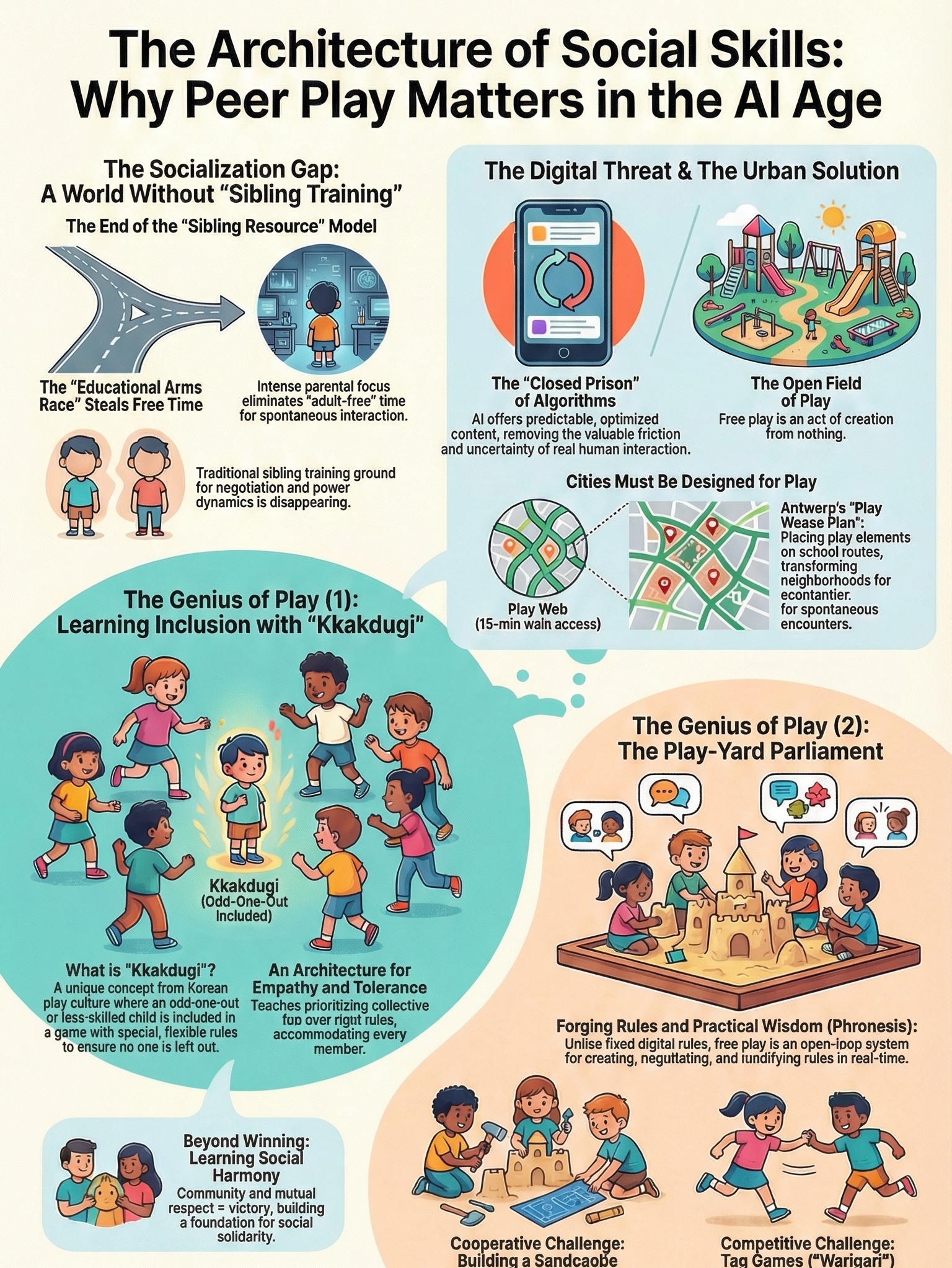
Based on the content of Chapter 8 (Sources–), here is the English translation formatted to match the style of the previous chapters.
Chapter 8. The 15-Minute City: A Spatial Sandbox for Restoring Human Autonomy
I. Capsular Civilization and the Lost Territory of Childhood
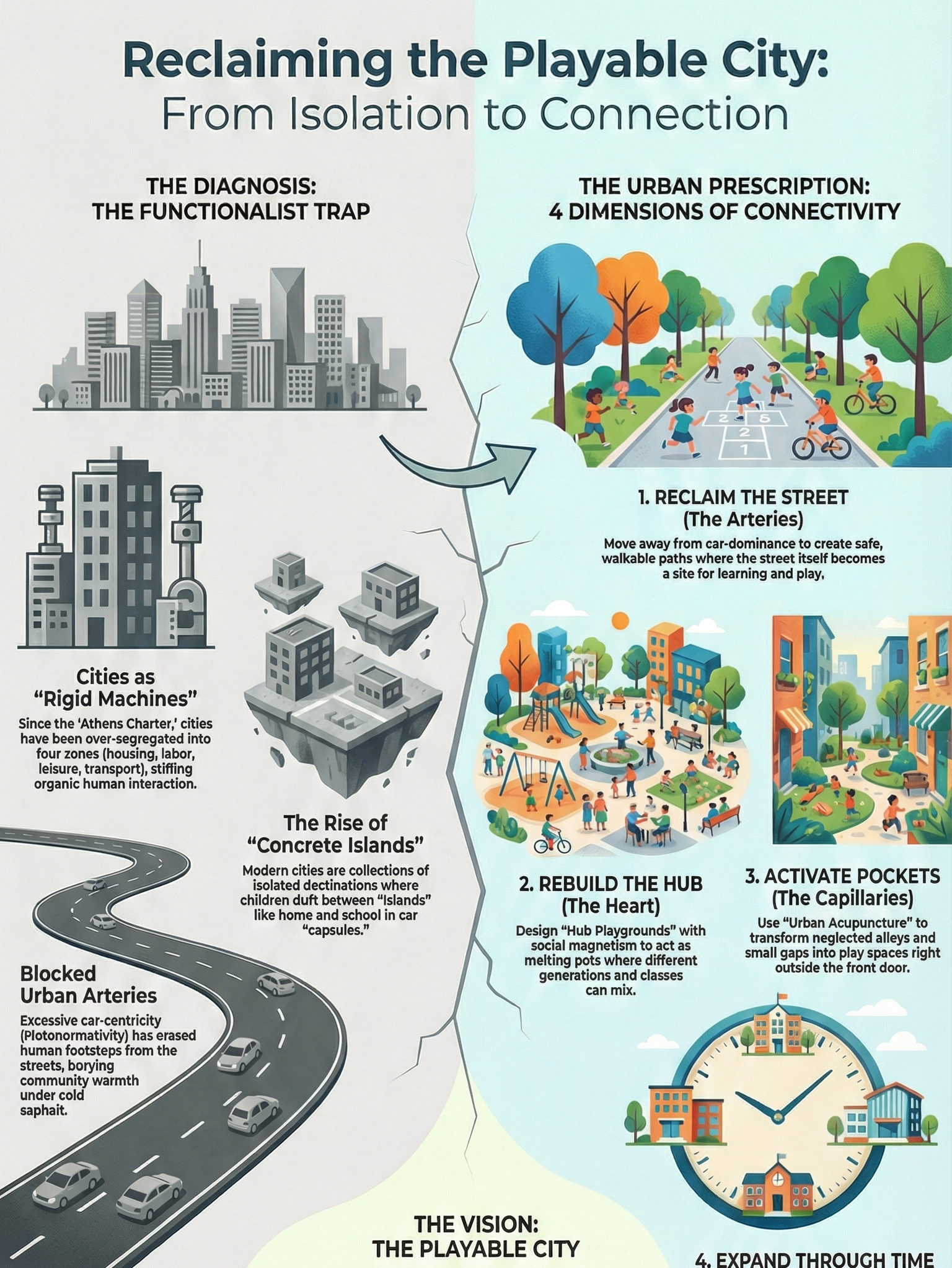
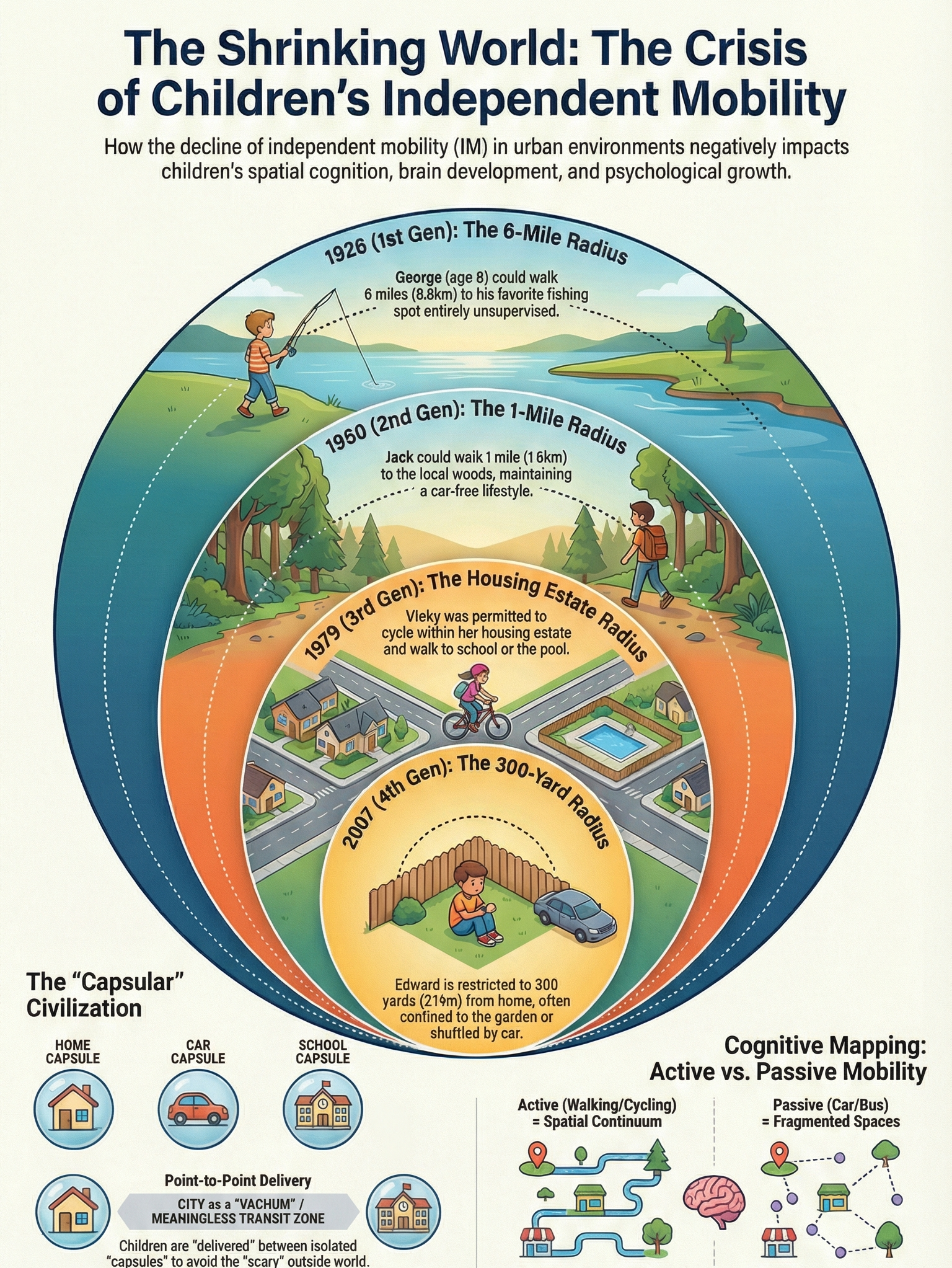
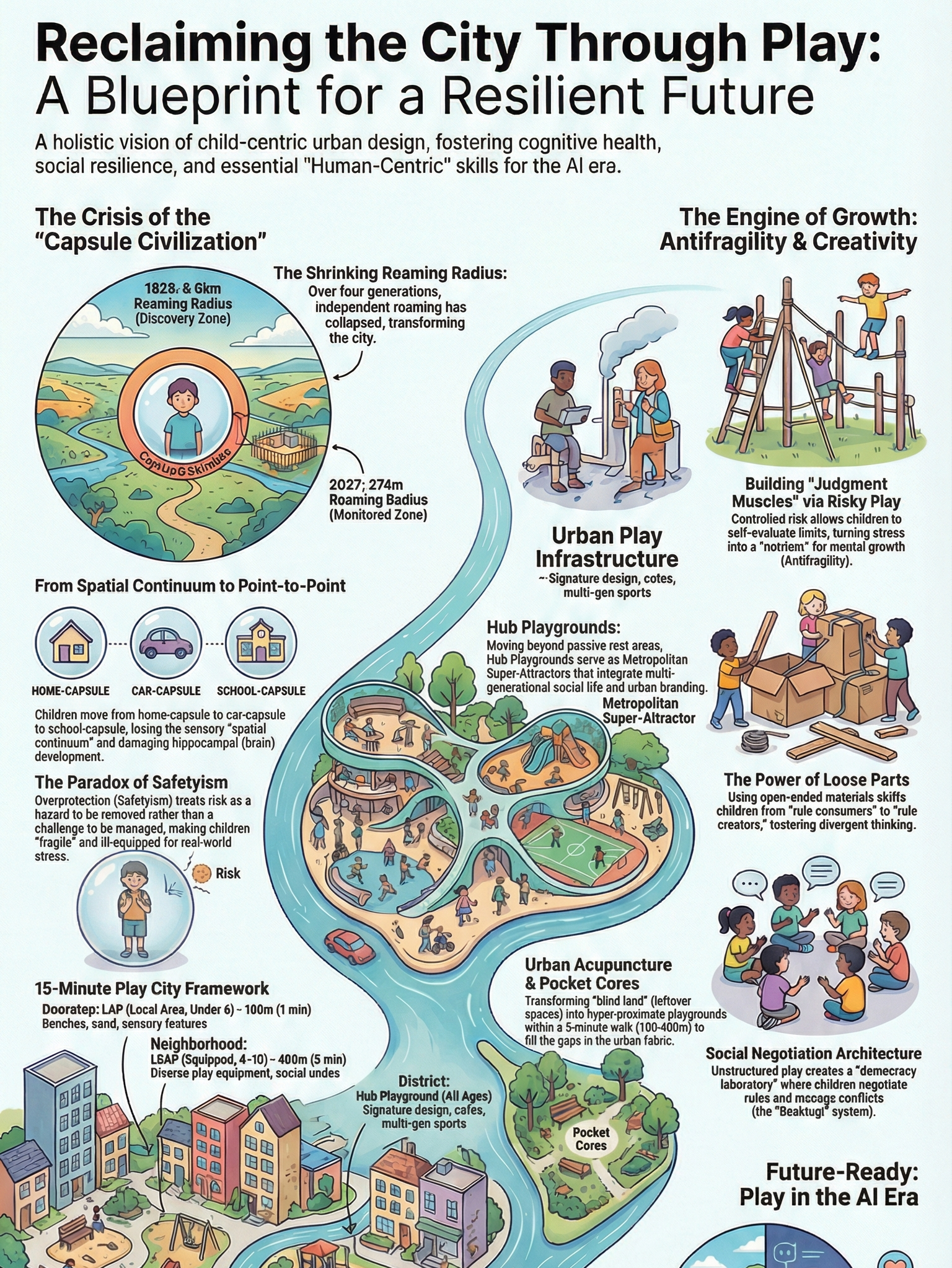
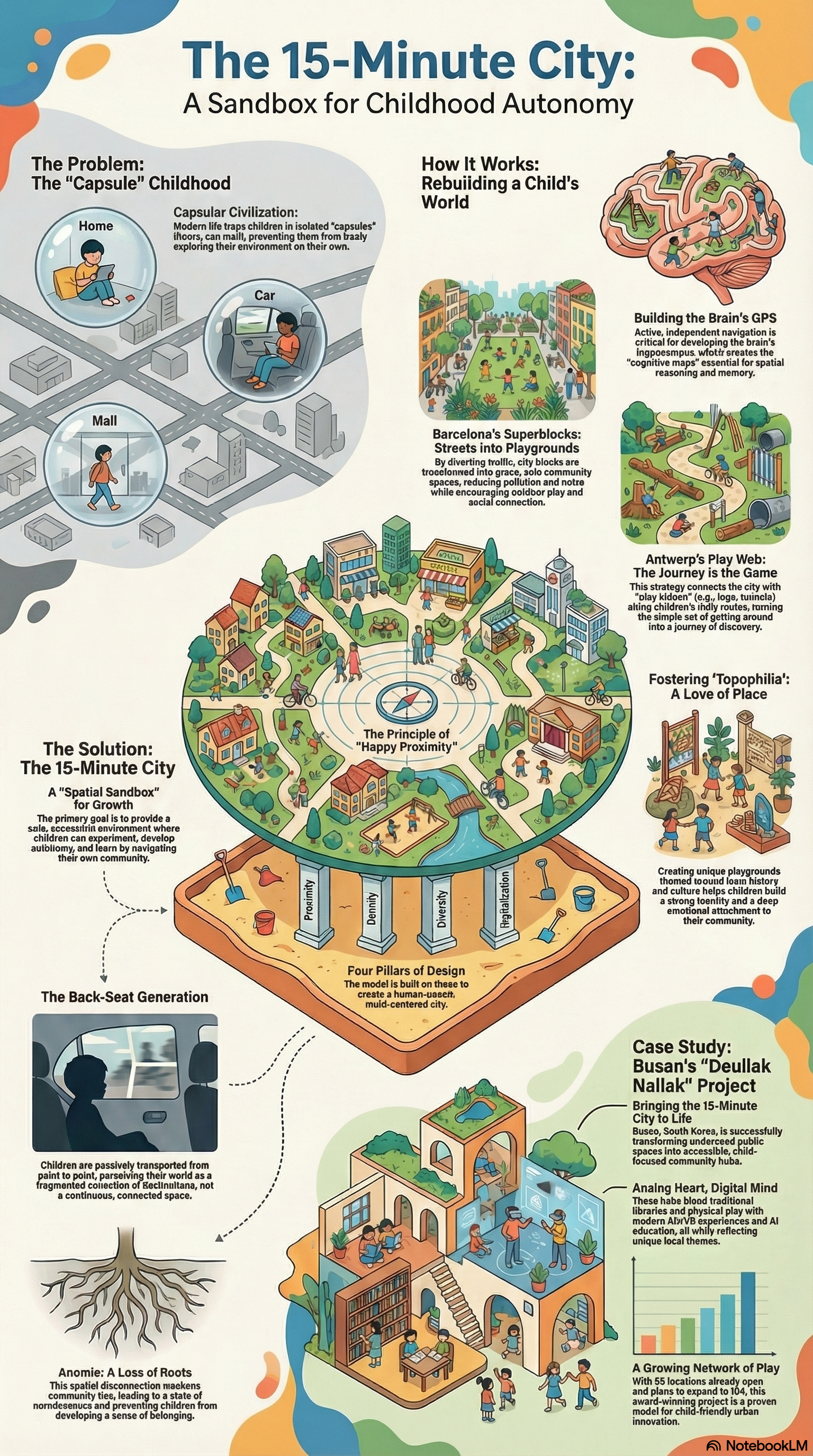
1.1. The Back-Seat Generation and Anomie Modern urban children live in the midst of what Lieven De Cauter termed "Capsular Civilization." This concept highlights the phenomenon where modern individuals, amidst environments dominated by fear, exclusion, and simulation, retreat into closed "capsules" such as cars, shopping malls, and gated communities. Specifically, rapid technological advancement and urban sprawl have fragmented daily life, resulting in the fatal loss of Independent Mobility (IM) for children. The "Back-seat Generation," moving from destination to destination in their parents' cars, fails to perceive their neighborhood as a continuous space, viewing it instead as a collection of fragmented points.
This spatial fragmentation deepens the state of "Anomie" warned of by Émile Durkheim. With loosened social norms and networks, children cannot take mental root in their local community and are left adrift. The 15-Minute City model can be defined as a "Spatial Sandbox" to cure these pathological phenomena of modern cities. It is a humanistic project aimed not merely at the efficiency of shortening physical distances, but at recovering human autonomy and restoring "Topophilia" (love of place).
II. Theoretical Foundation: Chrono-urbanism and the 15-Minute City
2.1. Happy Proximity and Polycentric Cities Professor Carlos Moreno's 15-Minute City model aims for an urban structure where residents can access essential social functions within a 15-minute walk or bike ride from their homes. Moreno calls this "Happy Proximity" and argues that the city's rhythm must be adjusted to the human stride, not the automobile. The core of this model is "Chrono-urbanism," focusing on the "value of time" rather than the "cost of time."
4 Core Elements of the 15-Minute CityDescription and Educational Implications
ProximityShortening physical distance to essential functions; Securing a radius where children can move without parents.
DensityOptimal population to sustain services; Increasing the frequency of social interaction.
DiversityMix of housing, work, commerce, health, education, and entertainment; Providing multi-layered social experiences.
DigitalizationSmart technology for service efficiency and accessibility; Ubiquitous learning environments.
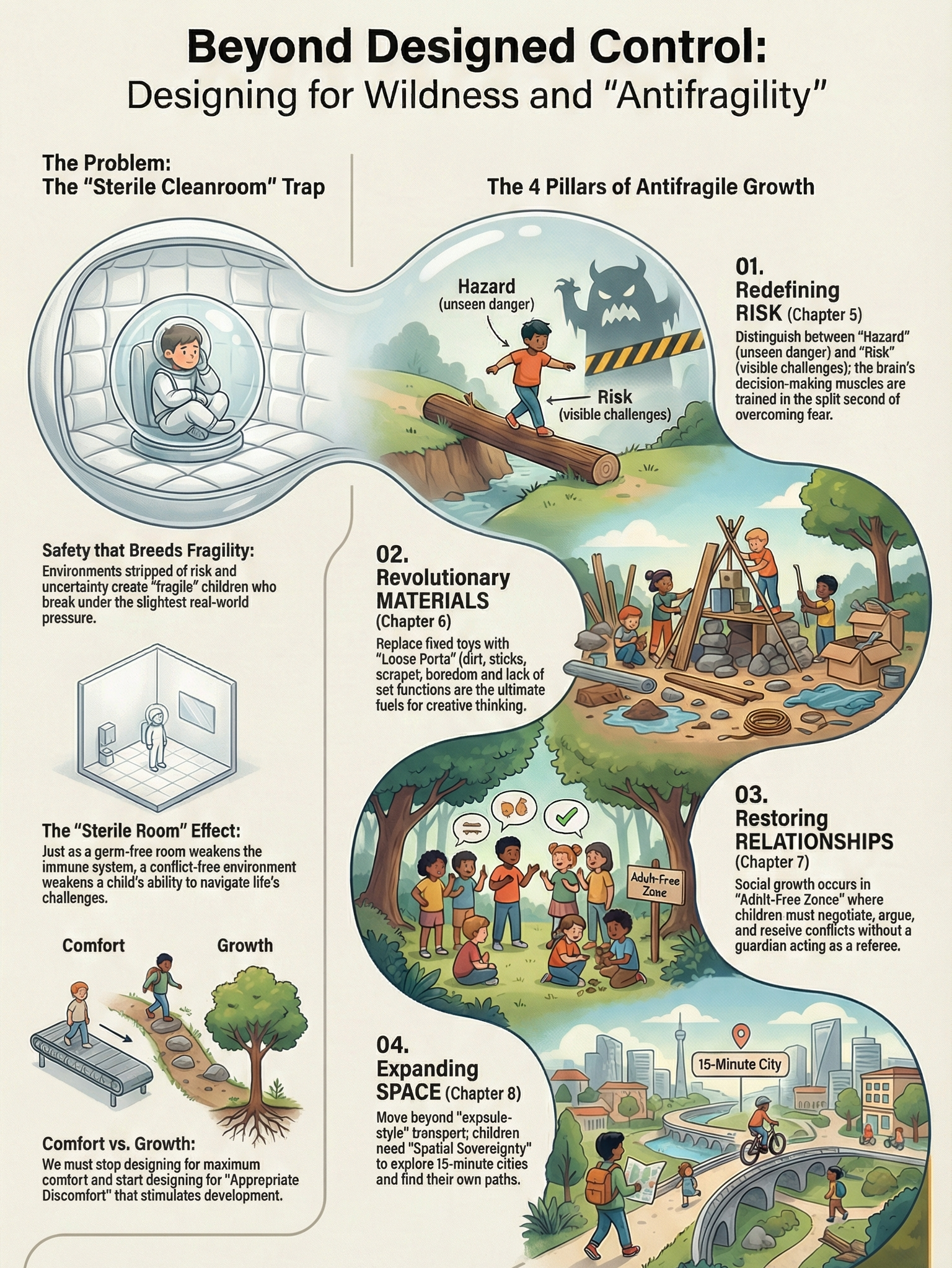
2.2. Rejecting Zoning: Reclaiming the Walkable Radius This model stands in direct opposition to the strict functional Zoning emphasized in Le Corbusier's Athens Charter (1933). While zoning geographically separated housing, work, and commerce—inevitably increasing car dependency—the 15-Minute City reconstructs the city into a Polycentric structure by mixing functions. This allows children to experience all elements of life within a 15-minute walk (approx. 1km radius).
III. Neuroscience of Independent Mobility: Building Cognitive Maps
3.1. Active Exploration and Hippocampal Development A child's independent mobility has a decisive impact on brain development, particularly the Hippocampus, the center of spatial cognition systems. The hippocampus creates a "Cognitive Map," an internal representation of the surrounding environment, enabling flexible navigation rather than simple rote memorization of routes.
Research shows that during active exploration, Place cells and Grid cells in the hippocampus are activated, encoding the relationship between the environment's geometry and landmarks. Conversely, children moved passively in cars are deprived of the opportunity to build these spatial relationships themselves. Neuroscience experiments indicate that the anterior hippocampus supports spatiotemporal integration, and childhood is the critical period for developing this ability.
3.2. 'Flickering' and Theta Sequences According to research by Dr. George Dragoi at Yale University, when exploring new environments, neural activity in the hippocampus "flickers" between the memorized map and the current environment, a process highly organized by Theta wave sequences. Active mobility stimulates this neuroplasticity, fostering the ability to manage unexpected detours, whereas passive mobility only teaches reactions to stimuli, leaving hippocampal resources underutilized. Furthermore, even 5-year-olds possess brain systems (Retrosplenial Complex, Occipital Place Area) that support map-based navigation, suggesting that when urban design is fine-tuned to a child's cognitive stride, children can accumulate far richer spatial experiences than adults.
IV. Spatial Mechanisms: Superblocks and the Play Web
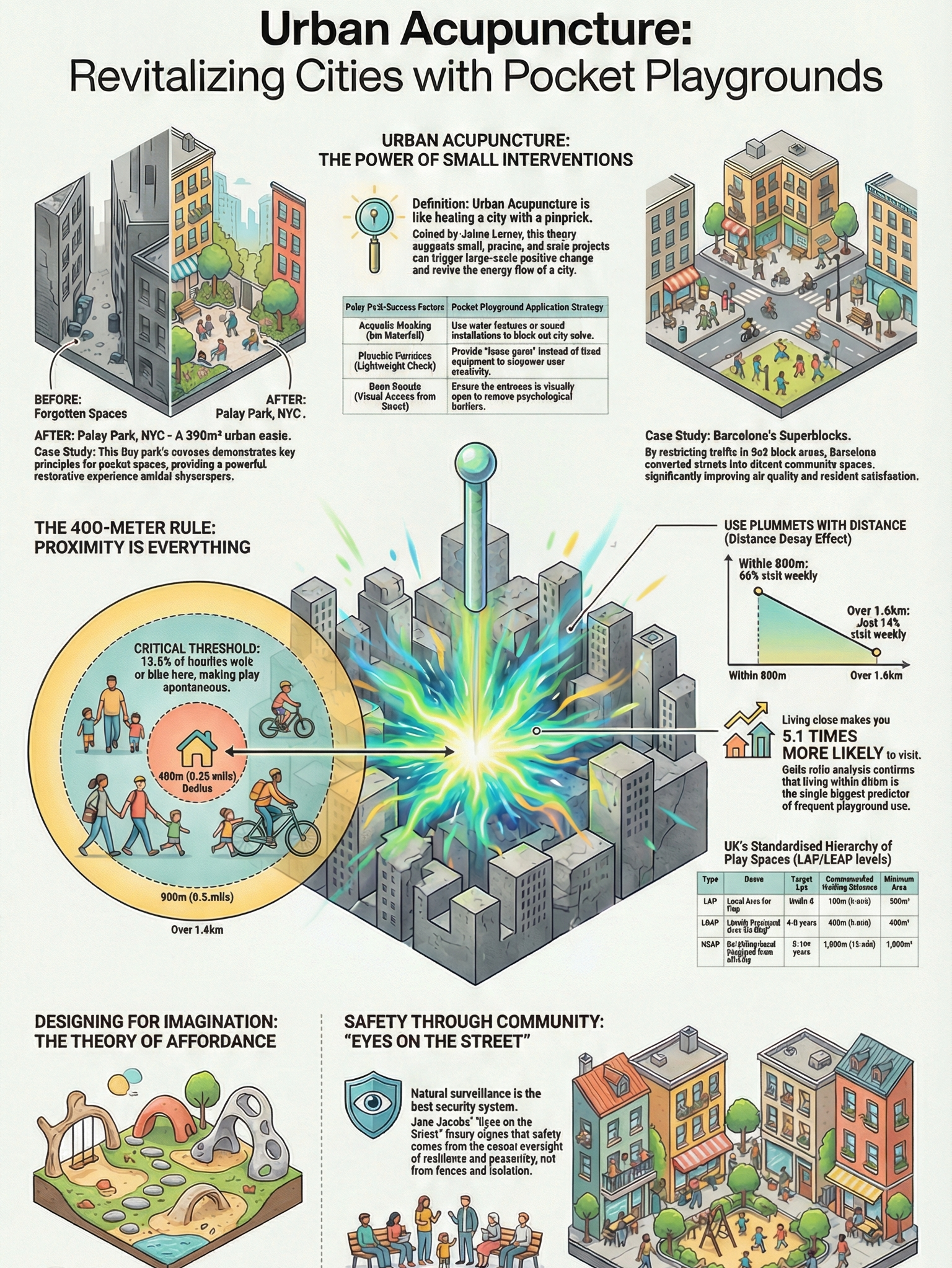
4.1. Barcelona's Superblocks: From Road to Place Barcelona's "Superblocks" (Superilles) bind existing 3x3 grid blocks into a single unit, limiting internal vehicle speed to 10km/h and diverting through-traffic to the perimeter. The reclaimed road space is transformed into communal spaces with greenery, benches, and play facilities.
Results: Since implementation, NO2 levels dropped by 25%, noise decreased, and social interactions (neighborly conversations and street play) increased significantly. Within Superblocks, the street becomes a "place to stay" rather than a "path to pass through." Children enter a safe play zone the moment they step out their door.
4.2. Antwerp's Play Web: Urban Design Based on Child's Cognitive Map Antwerp's "Speelweefselplan" (Play Web) moves away from building isolated playgrounds to connecting the entire city as a play network along children's actual movement routes. Using maps understandable by 8-year-olds, the city collected data on frequent destinations and danger spots. Based on this, "Play Stimuli" (stepping stones, tunnels, logs) were placed along paths, redefining the child's right to move from the perspective of play. This empowers children to enjoy a "journey of discovery" without excessive parental supervision.
V. Topophilia and Local Narratives: Themed Play Spaces
5.1. Playgrounds as Storytellers Each 15-Minute City must reflect its unique local history, environment, and culture. This is key to forming Topophilia (attachment to place). As Yi-Fu Tuan noted, abstract "Space" becomes meaningful "Place" through human experience. The Danish design firm Monstrum exemplifies this by creating "icons of place":
Zweibrücken Towers (Germany): Miniature replicas of local landmarks like the Karlskirche tower allow children to physically learn their hometown's history while playing tag.
Taarbæk Fishing Village: Reflecting the heritage of a fishing village with boat-shaped structures and giant Eider Duck sculptures, providing ecological education.
Verdi’s Operabox (Parma, Italy): Incorporating giant violins and opera themes to connect children with the city's musical traditions.
5.2. Rooting in the Community: Overcoming Anomie In an era of Anomie, where individuals feel separated from the group, themed play spaces within the 15-Minute City provide children with a "Center Point of Childhood." Exploring local history and nature and communicating autonomously with friends fosters a sense of belonging, transforming children from mere "residents" into "citizens."
VI. Case Study: Busan's 'Deullak Nallak'
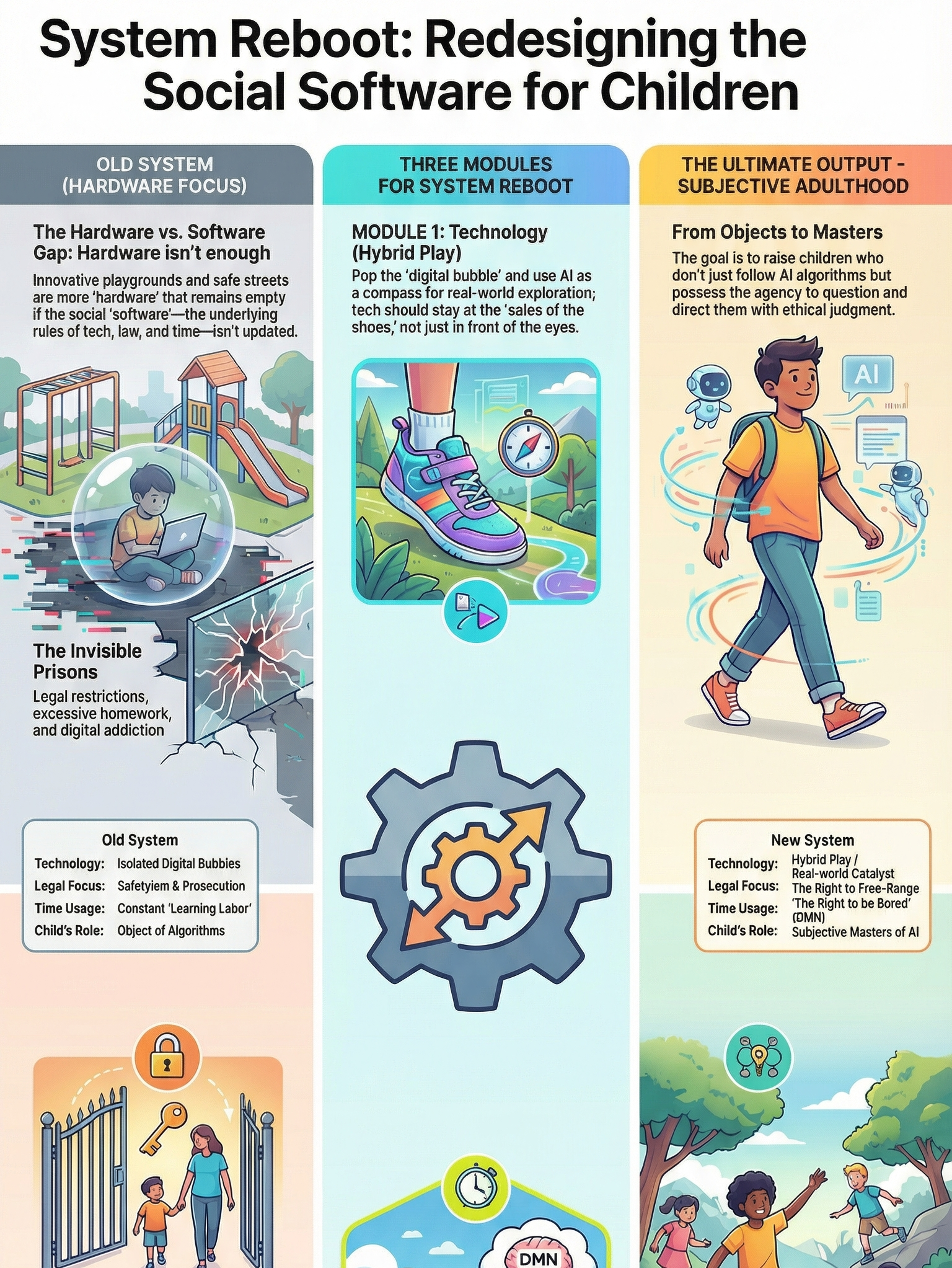
6.1. Hybrid Community Hubs Busan, South Korea, is implementing the 15-Minute City model through the "Children’s Complex Cultural Space: Deullak Nallak." This initiative remodels underused public facility lobbies and small libraries into hybrid analog-digital community hubs accessible within 15 minutes of home.
Modular Design: Customized placement of English Zones, Science Labs, and AR/VR Experience Zones based on space size.
Local Narrative: The "Sasang-maru" branch interprets the traditional Korean concept of "Maru" (living room/floor) to create a warm community space within a rigid administrative building.
Future Talent: Combining digital literacy education (AI/Coding) with play to bridge educational gaps. This policy, awarded the SDG City Award, demonstrates how social inclusivity can be realized by guaranteeing children's spatial rights.
VII. Conclusion: Autonomy Grown in a Sandbox
7.1. From Closed Islands to Open Networks While critics warn of gentrification or isolation, the 15-Minute City is not a "closed island" but a "Polycentric Network." Digital ubiquity complements physical limitations, and unique local themes incentivize children to explore different neighborhoods.
Paradigm Shift in Spatial PlanningCar-Centric City15-Minute Play City (Sandbox)
Subject of MobilityAdult DriverWalking Child & Traffic Vulnerable
Nature of SpacePassageway for Efficiency (Road)Street for Staying & Play (Street)
Cognitive ModeDiscontinuous Jumping (Capsular)Continuous Multidimensional Exploration (Web)
Psychological EffectAnomie & Spatial FearTopophilia & Emotional Stability
7.2. Designing for the Human Scale The 15-Minute City is a declaration to restore human territories encroached upon by technological civilization. The 15 minutes of free movement and play guaranteed to children awaken the brain's spatial capabilities, and play spaces imbued with local narratives engrave a mental map of "home" in their souls. Urban planners must now pay more attention to the child's stride and the texture of the space they perceive than to road width or traffic flow. A city where a child can walk safely and joyfully for 15 minutes is a truly "Human City" where all citizens can coexist with dignity and autonomy.
제8장. 공간적 샌드박스: 15분 도시와 자율성의 회복
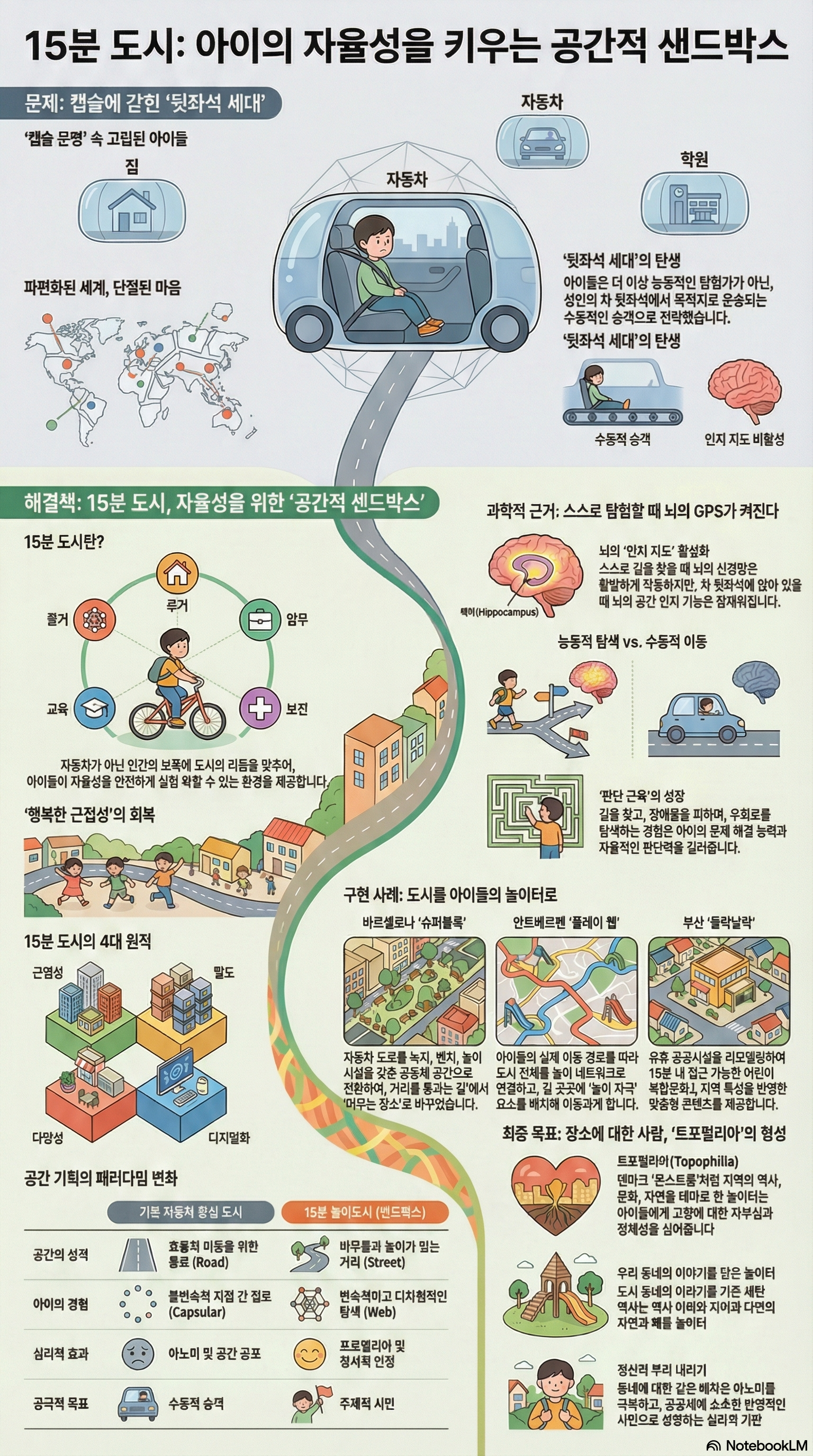
1. 캡슐에 갇힌 아이들: '뒷좌석 세대'의 비극
리벤 드 카우터(Lieven De Cauter)는 현대 도시를 **‘캡슐 문명(Capsular Civilization)’**이라 명명했다. 공포와 배제, 그리고 과도한 효율성이 지배하는 이 도시에서 인간은 자동차, 쇼핑몰, 아파트라는 폐쇄적인 캡슐 속으로 도피한다.
이러한 환경에서 가장 큰 피해자는 아동이다. 과거의 아이들이 동네 전체를 연속적인 흐름으로 경험했다면, 현대의 아이들은 부모의 자동차 뒷좌석에 실려 목적지 A에서 B로 점프하듯 이동한다. 이른바 **‘뒷좌석 세대(Back-seat generation)’**의 탄생이다. 이들에게 도시는 연결된 유기체가 아니라, 서로 관계없는 파편화된 점들의 집합일 뿐이다.
이 공간적 단절은 에밀 뒤르켐(Emile Durkheim)이 경고한 ‘아노미(Anomie)’ 상태를 가속화한다. 자신이 발 딛고 선 땅과 연결되지 못한 아이들은 지역사회에 정신적 뿌리를 내리지 못하고 부유하게 된다.
2. 크로노어바니즘(Chrono-urbanism): 시간의 '비용'에서 '가치'로
카를로스 모레노(Carlos Moreno) 교수가 제안한 **'15분 도시'**는 이 병리적 현상을 치유하기 위한 거대한 **'공간적 샌드박스'**다. 핵심은 도보나 자전거로 15분 이내에 주거, 업무, 상업, 의료, 교육, 엔터테인먼트라는 삶의 필수 기능에 접근할 수 있게 하는 것이다.
이는 단순히 이동 시간을 줄이는 효율성의 문제가 아니다. 모레노는 이를 **‘행복한 근접성(Happy Proximity)’**이라 부르며, 도시 계획의 초점을 시간의 ‘비용(Cost)’을 줄이는 것에서 시간의 ‘가치(Value)’를 높이는 것으로 전환해야 한다고 주장한다.
르 코르뷔지에의 '아테네 헌장'이 기능을 철저히 분리(Zoning)하여 아이들을 도로 위로 내몰았다면, 15분 도시는 기능을 섞고(Mix) 융합하여 아이들에게 안전하게 걸을 수 있는 권리를 돌려준다.
3. 뇌의 GPS를 켜라: 해마와 능동적 이동
왜 아이들은 스스로 걸어야 하는가? 그 해답은 뇌과학에 있다. 공간을 탐색하고 길을 찾는 행위는 뇌의 해마(Hippocampus)를 자극하여 **‘인지 지도(Cognitive map)’**를 형성하는 핵심 과정이다.
예일 대학교 조지 드라고이(George Dragoi) 박사의 연구에 따르면, 새로운 환경을 능동적으로 탐험할 때 뇌는 기억된 지도와 현실을 빠르게 비교하며(flickering) 신경망을 재조직한다. 쥐와 인간 모두 스스로 움직일 때 장소 세포(Place cells)와 격자 세포(Grid cells)가 활발히 작동하여 공간 감각을 깨운다.
반면, 수동적으로 이동하는 아이들의 뇌에서 이 기능은 꺼져 있다. 부모의 차에 실려 다니는 아이는 자극에 반응할 뿐, 공간을 해석하거나 구조화하지 못한다. 15분 도시는 아이들이 스스로 길을 잃고 다시 찾는 과정을 통해 뇌의 내비게이션 시스템을 단련할 수 있는 물리적 토대다.
4. 도로에서 광장으로: 슈퍼블록과 놀이망(Play Web)
아이들의 자율적 이동을 위해서는 자동차 중심의 공간 권력을 해체해야 한다. 바르셀로나의 **‘슈퍼블록(Superilles)’**과 안트베르펜의 **‘플레이 웹(Speelweefselplan)’**은 이를 증명하는 강력한 실증 사례다.
바르셀로나의 슈퍼블록: 9개 블록을 하나로 묶어 내부 차량 속도를 10km/h로 제한하고, 통과 교통을 차단했다. 아스팔트가 걷힌 자리는 놀이터와 벤치로 채워졌다. 그 결과 대기 오염과 소음이 감소했을 뿐만 아니라, 아이들의 거리 놀이 시간이 비약적으로 증가했다. 거리는 더 이상 ‘지나가는 곳’이 아니라 ‘머무는 곳’이 되었다.
안트베르펜의 플레이 웹: 점으로 존재하는 놀이터를 잇는 전략이다. 8세 아이들도 이해할 수 있는 지도를 바탕으로, 이동 경로 곳곳에 징검다리나 버드나무 터널 같은 ‘놀이 자극(Play stimuli)’을 심었다. 이동하는 길 자체가 거대한 놀이터가 되면서, 아이들은 부모의 감시 없이도 도시를 탐험하는 ‘발견의 여정’을 즐기게 되었다.
5. 토포필리아(Topophilia): 장소에 이야기를 입히다
물리적 거리만큼 중요한 것은 심리적 거리다. 15분 도시는 획일적인 신도시가 아니라, 그 지역만의 고유한 서사(Narrative)를 담아야 한다. 이푸 투안(Yi-Fu Tuan)은 이를 장소에 대한 깊은 애착, **‘토포필리아(Topophilia)’**라고 불렀다.
덴마크의 놀이터 디자인 기업 **몬스트룸(Monstrum)**은 이 철학을 완벽하게 구현한다.
츠바이브뤼켄 타워: 지역의 역사적 랜드마크를 축소 재현하여 아이들이 술래잡기를 하며 역사를 몸으로 익히게 한다.
타르베크 어촌 마을: 지역의 유산인 낚시 배와 어종을 형상화해 생태 교육과 지역 자부심을 동시에 제공한다.
이처럼 지역의 맥락(Context)이 담긴 공간에서 자란 아이는 단순한 거주자가 아니라, 그 땅의 역사와 문화를 공유하는 시민으로 성장한다.
6. 한국형 모델의 가능성: 부산의 '들락날락'
대한민국 부산의 **‘들락날락’**은 15분 도시 모델을 한국적 맥락으로 재해석한 성공 사례다. 15분 거리 내에 있는 노후 공공시설을 리모델링하여 아날로그와 디지털이 융합된 놀이 공간으로 탈바꿈시켰다.
특히 사상구청사의 ‘사상마루 들락날락’처럼 관공서의 딱딱한 공간을 아이들에게 내어주거나, 지역 특성에 맞는 테마(영어, 과학, 미디어아트)를 모듈식으로 적용하는 유연함은 주목할 만하다. 이는 15분 도시가 추구하는 사회적 포용성이 어떻게 구체적인 정책으로 실현될 수 있는지 보여준다.
7. 결론: 인간적인 도시를 향한 선언
15분 도시는 단순한 도시 계획 기법이 아니다. 그것은 기술과 속도에 의해 침탈당한 인간의 존엄과 아동의 자율성을 되찾기 위한 선언이다.
아이가 안전하게 15분을 걸을 수 있는 도시는, 곧 노인과 장애인을 포함한 모든 시민이 존중받는 도시다. 우리는 아이들을 캡슐에서 해방시켜야 한다. 그들이 자신의 두 발로 땅을 딛고, 친구들과 부대끼며, 스스로 길을 찾는 기쁨을 누릴 때, 비로소 도시는 ‘아노미’를 넘어선 진정한 ‘삶의 터전’이 될 것이다.
제8장. 15분 도시: 인간 자율성 회복을 위한 공간적 샌드박스
서론: 캡슐화된 문명과 상실된 아동의 영토
현대 도시의 아동들은 리벤 드 카우터(Lieven De Cauter)가 명명한 이른바 ‘캡슐 문명(Capsular Civilization)’의 한복판에 놓여 있다. 이 개념은 현대인이 공포와 배제, 그리고 시뮬레이션이 지배하는 환경 속에서 자동차, 쇼핑몰, 게이티드 커뮤니티(Gated communities)와 같은 폐쇄적인 ‘캡슐’ 속으로 도피하는 현상을 지적한다.1 특히 기술의 급격한 발전과 도시의 교외화는 일상을 분절시켰으며, 이는 아동들에게 있어 독립적인 이동성(Independent Mobility)의 상실이라는 치명적인 결과를 초래했다. 부모의 자동차 뒷좌석에 앉아 목적지에서 목적지로 점프하듯 이동하는 ‘뒷좌석 세대(Back-seat generation)’는 자신이 사는 동네를 연속적인 공간으로 인지하지 못하고, 파편화된 점들의 집합으로 받아들인다.4
이러한 공간적 분절은 에밀 뒤르켐(Emile Durkheim)이 경고한 ‘아노미(Anomie)’ 상태를 심화시킨다. 사회적 규범과 연결망이 느슨해진 상태에서 아동은 지역사회에 정신적 뿌리를 내리지 못하고 부유하게 된다. 15분 도시 모델은 이러한 현대 도시의 병리적 현상을 치유하기 위한 ‘공간적 샌드박스’로 정의될 수 있다. 이는 단순히 물리적 거리를 단축하는 효율성의 문제를 넘어, 인간의 자율성을 회복하고 공간에 대한 애착인 ‘토포필리아(Topophilia)’를 복원하기 위한 인문학적 기획이다.6 본 장에서는 15분 도시가 어떻게 아동의 독립적인 이동과 놀이 활동을 보장하는 접근성 및 근린성의 핵심 조건이 되는지, 그리고 각각의 놀이 공간이 지역적 맥락(Context)을 담아내는 테마를 통해 어떻게 아동의 정신적 기반을 형성하는지 심층적으로 분석하고자 한다.
15분 도시의 이론적 토대와 크로노어바니즘(Chrono-urbanism)
카를로스 모레노(Carlos Moreno) 교수가 제안한 15분 도시 모델은 도시 거주자가 주거지로부터 도보나 자전거로 15분 이내에 필수적인 사회적 기능에 접근할 수 있는 도시 구조를 지향한다.7 모레노는 이를 ‘행복한 근접성(Happy Proximity)’이라 부르며, 도시의 리듬을 자동차가 아닌 인간의 보폭에 맞추어야 한다고 주장한다.9 15분 도시의 핵심은 ‘크로노어바니즘’, 즉 시간의 비용(Time cost)이 아닌 시간의 가치(Time value)에 집중하는 것이다.7
15분 도시의 4가지 핵심 구성 요소
설명 및 아동 교육적 함의
근접성 (Proximity)
필수 기능에 대한 물리적 거리 단축; 아동이 부모 없이 이동 가능한 반경 확보 7
밀도 (Density)
서비스의 지속 가능성을 지탱하는 적정 인구; 사회적 상호작용의 빈도 증가 7
다양성 (Diversity)
주거, 업무, 상업, 의료, 교육, 엔터테인먼트의 혼합; 다층적 사회 경험 제공 7
디지털화 (Digitalization)
스마트 기술을 통한 서비스 효율화 및 접근성 보완; 유비쿼터스적 학습 환경 7
모레노의 모델은 제인 제이콥스(Jane Jacobs)의 근린 설계 개념과 클라렌스 페리(Clarence Perry)의 근린주구 이론에서 영감을 얻었으며, 주거(Living), 업무(Work), 공급(Commerce), 보건(Health), 교육(Education), 즐거움(Entertainment)이라는 6가지 필수 기능을 도시 구조 내에 재배치한다.7 아동에게 있어 이 모델은 ‘동네’라는 공간이 단순한 배경이 아니라, 자신의 자율성을 실험하고 확장할 수 있는 안전한 ‘샌드박스’가 됨을 의미한다.
15분 도시는 르 코르뷔지에(Le Corbusier)의 아테네 헌장(1933)이 강조했던 엄격한 기능적 구획(Zoning)에 정면으로 반대한다.11 아테네 헌장은 주거와 업무, 상업을 지리적으로 분리함으로써 필연적으로 장거리 통근과 자동차 의존도를 높였고, 이는 곧 아동의 보행권을 침탈하는 결과를 낳았다. 반면 15분 도시는 기능을 혼합하여 도시를 다중심적(Polycentric) 구조로 재구성함으로써, 아동이 보도로 15분(대략 반경 1km 이내) 내에서 삶의 모든 요소를 경험할 수 있게 한다.7
신경과학적 관점에서 본 독립적 이동의 가치
아동의 독립적인 이동성은 뇌 발달, 특히 공간 인지 시스템의 중추인 해마(Hippocampus) 형성에 결정적인 영향을 미친다. 해마는 주변 환경의 내부 표현인 ‘인지 지도(Cognitive map)’를 생성하는 역할을 하며, 이는 단순히 경로를 암기하는 것을 넘어 유연한 탐색을 가능하게 한다.12
최근 연구에 따르면, 쥐와 인간 모두 능동적인 탐색 과정에서 해마의 장소 세포(Place cells)와 격자 세포(Grid cells)가 활성화되며, 이는 환경의 기하학적 구조와 랜드마크 사이의 관계를 인코딩한다.13 반면, 부모의 차를 타고 수동적으로 이동하는 아동은 이러한 공간적 관계를 스스로 구축할 기회를 박탈당한다. 신경과학적 실험은 해마의 전방 부위가 시공간적 통합을 지원하며, 아동기가 이러한 통합 능력이 발달하는 핵심 시기임을 보여준다.15 15분 도시는 아동이 스스로 길을 찾고, 장애물을 피하며, 친구의 집이나 놀이터로 이동하는 과정에서 뇌의 GPS 기능을 강화할 수 있는 물리적 토대를 제공한다.
예일 대학교의 조지 드라고이(George Dragoi) 박사팀의 연구에 따르면, 새로운 환경을 탐험할 때 해마의 신경 활동은 기억된 지도와 현재의 환경 사이를 ‘깜박거리며(flickering)’ 비교하는데, 이러한 과정은 쎄타(Theta) 파형 시퀀스에 의해 고도로 조직화된다.12 능동적 이동은 이러한 신경 가소성을 자극하여 예기치 못한Detour(우회로)를 운영할 수 있는 능력을 키워주지만, 수동적 이동은 단순히 자극에 대한 반응만을 학습하게 하여 해마 자원을 활용하지 못하게 만든다.12
또한, 5세 정도의 어린 아동도 이미 랜드마크를 기반으로 한 지도형 항법(Map-based navigation)을 지원하는 뇌 시스템을 갖추고 있음이 밝혀졌다.18 특히 후대상 복합체(Retrosplenial Complex, RSC)는 장소들을 더 큰 공간 내의 적절한 위치로 매핑하여 항법을 가능하게 하며, 후두 장소 영역(Occipital Place Area, OPA)은 주변의 물리적 장애물을 인식하여 보행을 돕는다.18 이러한 신경과학적 증거는 도시 설계가 아동의 인지적 보폭에 맞추어 세밀하게 조정될 때, 아동은 성인보다 훨씬 더 감각적이고 풍부한 공간 경험을 축적할 수 있음을 시사한다.
공간적 기제: 슈퍼블록과 놀이망(Play Web)
아동의 자율적 이동을 보장하기 위해서는 자동차의 위협으로부터 자유로운 물리적 공간의 재구성이 필수적이다. 바르셀로나의 슈퍼블록(Superilles)과 안트베르펜의 플레이 웹(Speelweefselplan)은 이를 구현한 대표적인 사례다.
바르셀로나의 슈퍼블록: 도로에서 광장으로의 전환
바르셀로나는 기존의 3x3 그리드 블록을 하나의 단위로 묶어 내부 통행 차량의 속도를 걷는 속도(10km/h)로 제한하고, 통과 교통을 외곽 도로로 우회시킨다.19 이를 통해 확보된 도로 공간은 아스팔트를 걷어내고 녹지, 벤치, 놀이 시설을 갖춘 공동체 공간으로 탈바꿈한다. 2016년 이후 포블레누(Poblenou), 산 안토니(Sant Antoni), 오르타(Horta) 등에서 시행된 실험은 놀라운 성과를 거두었다.21
슈퍼블록의 환경적/사회적 효과
데이터 및 연구 결과
대기 오염 감소
NO2 농도 25% 감소, PM10 입자 17% 감소
소음 저감
차량 통행 차단으로 인한 심리적 평온함 및 수면 질 개선
신체 활동 증가
보행 편의성 증대로 주민의 60% 이상이 걷기에 더 쾌적하다고 응답
사회적 상호작용
이웃 간 대화 빈도 및 아동의 거리 놀이 시간 비약적 증가
슈퍼블록 내에서 거리는 더 이상 ‘통과하는 경로’가 아니라 ‘머무는 장소’가 된다. 아동은 집 문을 나서는 순간부터 안전한 놀이 영역에 진입하며, 이는 주거 공간의 확장을 의미한다.24 특히 ‘학교 보호(Protegim les escoles)’ 구상을 통해 학교 주변을 안전하고 건강한 공공 공간으로 조성함으로써, 학교가 지역 사회의 놀이 허브로 기능하게 한다.26
안트베르펜의 플레이 웹: 아동의 인지 지도를 기반으로 한 도시 설계
안트베르펜의 ‘스펠베프설플란(Speelweefselplan)’은 개별 놀이터를 짓는 방식에서 벗어나, 아동이 실제로 이동하는 경로를 따라 도시 전체를 하나의 놀이 네트워크로 연결하는 전략이다.27 이 전략은 8세 아동도 이해할 수 있는 지도를 활용하여 아동들이 자주 가는 장소, 위험하다고 느끼는 지점, 친구를 만나는 거점을 직접 제보하게 한다.28
이렇게 수집된 데이터를 바탕으로 ‘요구 프로그램(Programme of demands)’이 작성되며, 이동 경로상에 ‘놀이 자극(Play stimuli)’을 배치한다. 예를 들어, 단순한 보행로에 징검다리 모양의 콘크리트 돌, 나무 기둥, 버드나무 터널 등을 설치하여 아동이 이동하는 행위 자체를 놀이로 인지하게 만든다.27 이는 아동의 이동권을 보행의 관점이 아닌 ‘놀이의 관점에서 재정의’한 혁신적인 접근이다. 안트베르펜은 이를 통해 아동이 부모의 과도한 감독 없이도 장소를 이동하며 스스로 ‘ journey of discovery’를 즐길 수 있는 환경을 구축했다.30
토포필리아와 테마 중심의 지역색 구현
각각의 15분 도시는 천편일률적인 모습이 아니라, 해당 지역의 역사, 환경, 자연, 문화를 반영한 독특한 테마를 가져야 한다. 이는 아동이 자신이 자란 곳에 대한 정체성을 형성하고, 공간에 대한 깊은 애착인 ‘토포필리아’를 갖게 하는 핵심적인 기제다.6 이푸 투안(Yi-Fu Tuan)에 따르면 공간(Space)은 의미가 없는 추상적인 영역이지만, 인간의 경험이 투영될 때 비로소 장소(Place)로 변모한다.6 아동기 놀이 경험은 빈 캔버스와 같은 공간을 풍부한 의미를 지닌 장소로 탈바꿈시키는 가장 강력한 도구다.
놀이터의 조형물과 지역적 서사(Narrative)
덴마크의 놀이터 디자인 기업인 몬스트룸(Monstrum)의 사례는 놀이 공간이 어떻게 지역의 이야기를 담아내는 조각품이 될 수 있는지 잘 보여준다. 이들은 전통적인 기성 기구에서 벗어나 시각 예술과 스토리텔링, 신체적 도전이 교차하는 ‘장소의 아이콘’을 창조한다.33
츠바이브뤼켄 타워(Zweibrücken Towers): 독일의 ‘장미의 도시’ 츠바이브뤼켄에 위치한 이 놀이터는 지역의 상징적 건축물인 카를교 교회 타워와 폴란드 왕 스타니슬라스 레슈친스키의 바로크 가옥인 츠시플리크(Tschifflik)를 미니어처로 재현했다. 아동들은 술래잡기를 하며 자연스럽게 고향의 역사적 랜드마크를 몸으로 익힌다.33
타르베크 어촌 마을과 아이더 오리(Taarbæk Fishing Village): 외레순 해협의 작은 어촌이었던 타르베크의 유산을 반영하여, 낚시 배 모양의 조형물과 물고기 이름이 적힌 놀이 집들을 배치했다. 지역에 흔한 아이더 오리를 거대하게 형상화한 구조물은 아동들에게 생태 교육과 지역 유산에 대한 자부심을 동시에 제공한다.34
베르디의 오페라 박스(Verdi’s Operabox): 이탈리아 파르마의 테아트로 레지오 오페라 하우스에서 영감을 받아 제작된 이 놀이터는 거대한 바이올린과 오페라 무대 테마를 통해 도시의 음악적 전통을 아동의 놀이 행위와 연결한다.33
놀이터에 사용되는 색상과 재료 또한 지역색을 반영한다. 해안 지역에서는 밧줄과 모래, 나무 판재를 사용하여 항구의 느낌을 살리고, 숲이 가까운 곳에서는 거친 질감의 통나무와 바위, 흙의 색조를 사용하여 자연과의 일체감을 높인다.36 몬스트룸은 특히 내구성이 뛰어나고 환경 친화적인 시베리아 잎새나무(Larch)와 로비니아(Robinia) 목재를 사용하여 물리적 건강과 정서적 안정을 동시에 도모한다.33 이러한 감각적 경험은 아동의 기억 속에 ‘우리 동네만의 향기와 질감’으로 남게 된다.
정신적 뿌리 내리기: 아노미 극복과 심리적 안정
현대 사회의 아노미는 개인이 집단과 분리되어 가치관의 혼란을 겪는 상태를 의미한다. 아동에게 있어 ‘동네’라는 구체적인 장소가 상실될 때, 이들은 자신의 존재를 지탱할 사회적 지지대를 잃게 된다. 15분 도시 내의 테마 중심 놀이 공간은 아동에게 ‘어린 시절의 중심점’을 제공한다.38
이런 자연스러운 정신적 기반은 아동이 지역사회에 정신적 뿌리를 내리는 안정적인 심리 상태를 가져온다. 자신이 사는 곳의 역사와 자연을 탐험하고, 그 안에서 친구들과 자율적으로 소통하는 경험은 아동이 단순한 ‘거주자’를 넘어 ‘시민’으로 성장하는 발판이 된다. 이 과정에서 획득되는 안정감은 변화무쌍한 현대 사회에서 아동이 가질 수 있는 가장 강력한 심리적 방어 기제가 된다.38 특히 아동의 정체성 형성은 그들이 머무는 물리적 환경과의 트랜잭션(Transaction)을 통해 이루어지며, 장소에 대한 애착이 높은 아동일수록 자아 존중감과 미래에 대한 비전 형성 능력이 높다.39
사례 연구: 부산의 ‘들락날락’과 15분 도시 정책
대한민국의 부산광역시는 15분 도시 모델을 ‘어린이 복합문화공간 들락날락’이라는 브랜드를 통해 적극적으로 구현하고 있다. 이는 낙후되거나 유휴화된 공공시설 로비, 작은 도서관 등을 리모델링하여 아동과 부모가 집 근처에서 15분 이내에 접근할 수 있는 아날로그-디지털 융합형 커뮤니티 거점을 조성하는 사업이다.41
디자인 가이드라인과 지역 맞춤형 콘텐츠
부산시는 ‘들락날락’의 일관된 브랜드 이미지를 유지하면서도 각 지역의 특성에 맞는 디자인을 적용하기 위해 가이드라인을 수립했다.43
모듈식 공간 구성: 면적과 위치에 따라 도서실, 영어 존(English Zone), 과학실, 미디어아트 전시, AR/VR 체험 존 등을 맞춤형으로 배치한다. 이는 공간의 효율성을 극대화하면서도 아동의 다양한 발달 요구를 수용한다.43
지역적 서사 반영: 사상구청사에 조성된 ‘사상마루 들락날락’은 전통 가옥의 ‘마루’라는 개념을 차용하여, 세대와 지역 주민이 자유롭게 오가며 소통하는 따뜻한 공동체의 장을 테마로 삼았다.45 이는 행정 관청이라는 딱딱한 공간을 아동 친화적인 ‘장소’로 치환한 사례다.
디지털 교육과 미래 인재 양성: 영어상용도시 조성과 연계하여 실감형 콘텐츠를 통해 영어를 친숙하게 접하게 하고, 코딩 및 AI 교육 프로그램을 병행하여 디지털 세대의 흥미를 유발한다.43
‘들락날락’ 정책은 아동이 도심 속에서 겪는 교육 서비스의 격차를 해소하고, 정주 여건을 개선하는 우수한 도시 혁신 모델로 평가받아 ‘SDG 시티 어워즈’ 대상을 수상했다.48 현재 부산 전역에 55곳이 운영 중이며, 향후 104곳까지 확대될 예정이다.50 이는 15분 도시가 추구하는 ‘사회적 포용성’이 아동의 공간권을 보장함으로써 실현될 수 있음을 증명한다.
15분 도시와 사회적 통합의 과제
15분 도시는 많은 기회를 제공하지만, 그 구현 과정에서 발생할 수 있는 비판적 쟁점들도 존재한다. 에드워드 글레이저(Edward Glaeser)와 같은 학자들은 15분 도시가 특정 지역을 고립시키고 젠트리피케이션을 유발하여 오히려 사회적 격차를 심화시킬 수 있다고 경고한다.8 아동 교육적 관점에서도 특정 근린 구역 내에만 머무는 것이 아동의 사회적 시야를 좁힐 수 있다는 우려가 있다.
그러나 모레노의 핵심 답변은 15분 도시가 ‘닫힌 섬’이 아니라 ‘다중심적 연결망’이라는 점이다. 디지털 기술(Ubiquity)은 물리적 거리의 한계를 보완하며, 지역마다 다른 테마의 놀이 공간은 아동이 자신의 동네를 넘어 다른 동네를 ‘탐험’하고 싶게 만드는 유인이 된다. 즉, 15분 도시는 아동을 가두는 울타리가 아니라, 안전하게 날아오르기 위한 활주로와 같은 역할을 수행해야 한다.
공간 기획의 패러다임 변화
기존의 자동차 중심 도시
15분 놀이도시 (샌드박스)
이동 주체
성인 운전자
보행 아동 및 교통 약자 8
공간 성격
효율적 이동을 위한 통로 (Road)
머무름과 놀이가 있는 거리 (Street) 24
인지 방식
불연속적 지점 간 점프 (Capsular)
연속적이고 다차원적인 탐색 (Web) 29
심리 효과
아노미 및 공간 공포
토포필리아 및 정서적 안정 38
사회 기능
엄격한 기능 분리 (Zoning)
유연한 복합 용도 활용 7
결론: 샌드박스에서 자라나는 미래의 자율성
15분 도시는 단순한 도시 계획의 방법론을 넘어, 기술 문명에 의해 침탈당한 인간의 자율 영토를 복원하려는 선언이다. 아동에게 보장된 15분간의 자유로운 이동과 놀이는 뇌의 공간적 능력을 일깨우고, 지역의 서사가 담긴 놀이 공간은 이들의 영혼에 고향이라는 정신적 지도를 새긴다.
아동은 15분 놀이도시라는 ‘공간적 샌드박스’ 안에서 친구들과 함께 동네를 발견하고 탐험하며, 그 과정에서 타인과 관계 맺는 법과 스스로 결정하는 법을 배운다. 이러한 경험을 통해 형성된 토포필리아는 성인이 된 후에도 지역사회에 대한 책임감과 애착으로 이어진다. 결국 15분 도시는 아동이 아노미 상태의 방관자가 아니라, 자신의 삶의 터전인 공간에 깊이 뿌리 내린 주체적인 인간으로 성장하게 하는 가장 기본적이고도 강력한 환경적 장치다.
도시 설계자들과 정책 결정자들은 이제 도로의 폭이나 차량의 소통량보다 아동의 보폭과 이들이 느끼는 공간의 질감에 더 주목해야 한다. 아동이 안전하고 즐겁게 15분을 걸을 수 있는 도시는, 곧 모든 시민이 존엄과 자율을 누리며 공존할 수 있는 진정한 의미의 ‘인간적인 도시’이기 때문이다. 15분 도시는 우리 아이들이 캡슐이라는 감옥에서 벗어나, 살아있는 장소로서의 세상을 마음껏 호흡할 수 있게 하는 희망의 지도가 될 것이다.
참고 자료
The Capsular Civilization. On the City in the Age of Fear Rotterdam - Vrije Universiteit Brussel, 1월 4, 2026에 액세스, https://researchportal.vub.be/en/publications/the-capsular-civilization-on-the-city-in-the-age-of-fear-rotterda/
The Capsular Civilization - nai010 uitgevers / publishers, 1월 4, 2026에 액세스, https://www.nai010.com/en/product/the-capsular-civilization/
The capsular civilization : on the city in the age of fear / Lieven De Cauter. - Canadian Centre for Architecture, 1월 4, 2026에 액세스, https://www.cca.qc.ca/fr/recherche/details/library/publication/58422065
Investigating social inequalities in children's independent mobility, active transportation and outdoor free play in two Canadian cities - PMC - NIH, 1월 4, 2026에 액세스, https://pmc.ncbi.nlm.nih.gov/articles/PMC10861842/
Child Independent Mobility: Making the Case, and Understanding How the Physical and Social Environments Impact on the Behaviour - ResearchGate, 1월 4, 2026에 액세스, https://www.researchgate.net/publication/280015323_Child_Independent_Mobility_Making_the_Case_and_Understanding_How_the_Physical_and_Social_Environments_Impact_on_the_Behaviour
Topophilia → Term - Lifestyle → Sustainability Directory, 1월 4, 2026에 액세스, https://lifestyle.sustainability-directory.com/term/topophilia/
15-minute city - Wikipedia, 1월 4, 2026에 액세스, https://en.wikipedia.org/wiki/15-minute_city
The 15-Minute City - Transformative Urban Mobility Initiative, 1월 4, 2026에 액세스, https://www.transformative-mobility.org/wp-content/uploads/2023/03/TUMI_The-15-Minute-City_2021-07-75xNWP.pdf
New book! The 15-Minute City: A Solution to Saving Our Time and Our Planet, 1월 4, 2026에 액세스, https://www.moreno-web.net/new-book-the-15-minute-city-a-solution-to-saving-our-time-and-our-planet/
The 15 minutes-city: for a new chrono-urbanism! - Pr Carlos Moreno, 1월 4, 2026에 액세스, https://www.moreno-web.net/the-15-minutes-city-for-a-new-chrono-urbanism-pr-carlos-moreno/
15-Minute City: An Attempt to Measure Proximity to Urban Services in Rome - Preprints.org, 1월 4, 2026에 액세스, https://www.preprints.org/manuscript/202409.1182
The Brain Navigates New Spaces by 'Flickering' Between Reality and Old Mental Maps, 1월 4, 2026에 액세스, https://medicine.yale.edu/news-article/brain-navigates-new-spaces-by-flickering-between-reality-and-old-mental-maps/
The cognitive map in humans: Spatial navigation and beyond - PMC - PubMed Central, 1월 4, 2026에 액세스, https://pmc.ncbi.nlm.nih.gov/articles/PMC6028313/
Flexible navigation with neuromodulated cognitive maps - bioRxiv, 1월 4, 2026에 액세스, https://www.biorxiv.org/content/biorxiv/early/2025/09/04/2025.09.04.674155.full.pdf
Development of anterior hippocampal integration underlies the protracted emergence of cognitive map formation and generalization - bioRxiv, 1월 4, 2026에 액세스, https://www.biorxiv.org/content/10.64898/2025.12.11.693744v1.full.pdf
Hippocampal-neocortical functional reorganization underlies children's cognitive development - PMC - PubMed Central, 1월 4, 2026에 액세스, https://pmc.ncbi.nlm.nih.gov/articles/PMC4286364/
Virtual navigation strategies from childhood to senescence: evidence for changes across the life span - Frontiers, 1월 4, 2026에 액세스, https://www.frontiersin.org/journals/aging-neuroscience/articles/10.3389/fnagi.2012.00028/full
Five-Year-Olds Can Navigate Maps Using Adultlike Brain Systems - Neuroscience News, 1월 4, 2026에 액세스, https://neurosciencenews.com/child-navigation-neuroscience-28885/
Barcelona Superblocks: Reclaiming Streets For People - Urban Design lab, 1월 4, 2026에 액세스, https://urbandesignlab.in/barcelona-superblocks-reclaiming-streets-for-people/
Kid-friendly superblocks: Can residents reclaim the streets? - City Monitor, 1월 4, 2026에 액세스, https://www.citymonitor.ai/analysis/kid-friendly-superblocks-residents-reclaim-streets/
The Superblock Programme in Barcelona - Columbia Academic Commons, 1월 4, 2026에 액세스, https://academiccommons.columbia.edu/doi/10.7916/shtg-jg82
Barcelona: Using urban design to improve urban health - World Health Organization (WHO), 1월 4, 2026에 액세스, https://www.who.int/news-room/feature-stories/detail/barcelona-using-urban-design-to-improve-urban-health
SUPERBLOCKS - Kleinman Center for Energy Policy - University of Pennsylvania, 1월 4, 2026에 액세스, https://kleinmanenergy.upenn.edu/wp-content/uploads/2020/08/Superblocks-1.pdf
The implementation of the Superblocks programme in Barcelona: Filling our streets with life, 1월 4, 2026에 액세스, https://www.c40.org/case-studies/barcelona-superblocks/
Mastering mobility with child-friendly mobility planning - Knowledge Hub - EIT Urban Mobility, 1월 4, 2026에 액세스, https://www.eiturbanmobility.eu/knowledge-hub/mastering-mobility-with-child-friendly-mobility-planning/
URBAN LOOPS OF PLAY - UPCommons, 1월 4, 2026에 액세스, https://upcommons.upc.edu/bitstreams/7b84e94f-875e-48c5-af1a-c82bff497f76/download
Lessons from Antwerp | Designing Child Friendly Neighbourhoods - Cities for Play, 1월 4, 2026에 액세스, https://www.citiesforplay.com/lessonsfromantwerp
Antwerp's Play Space Web: smart, child-friendly neighbourhood planning in action, 1월 4, 2026에 액세스, https://rethinkingchildhood.com/2018/03/07/antwerp-play-space-web-smart-child-friendly-neighbourhood-urban-planning/
How two Belgian cities turned their pavements into playgrounds - Apolitical, 1월 4, 2026에 액세스, https://apolitical.co/solution-articles/en/how-two-belgian-cities-turned-their-pavements-into-playgrounds
Play spaces for children to move freely in cities are growing scarcer - Apolitical, 1월 4, 2026에 액세스, https://apolitical.co/solution-articles/en/how-to-create-a-child-friendly-city
Antwerp's ambitious mobility strategy: A blueprint for sustainable urban transport, 1월 4, 2026에 액세스, https://www.polisnetwork.eu/news/antwerps-ambitious-mobility-strategy-a-blueprint-for-sustainable-urban-transport/
Yi-Fu Tuan → Term - Lifestyle → Sustainability Directory, 1월 4, 2026에 액세스, https://lifestyle.sustainability-directory.com/term/yi-fu-tuan/
PLAYGROUNDS OF IDENTITY | Monstrum, 1월 4, 2026에 액세스, https://monstrum.dk/en/article/playgrounds-identity
THE DRAWING ISSUE - Monstrum Playgrounds, 1월 4, 2026에 액세스, https://monstrum.dk/en/article/drawing-issue
The Fishing Village and the Eider Duck - Monstrum Playgrounds, 1월 4, 2026에 액세스, https://monstrum.dk/en/playground/fishing-village-and-eider-duck
Themed Playground Ideas That Engage Kids and Communities, 1월 4, 2026에 액세스, https://www.playgroundequipment.com/themed-playground-ideas-that-engage-kids-and-communities/
Integrating Landscape Design & Playground Elements | Playworld, 1월 4, 2026에 액세스, https://playworld.com/blog/integrating-landscape-design-playground-elements/
Topophilia: The Interplay of Place and Emotion - Free Essay Example - Edubirdie, 1월 4, 2026에 액세스, https://hub.edubirdie.com/examples/topophilia-and-the-life-critical-essay/
What about Place? Considering the Role of Physical Environment on Youth Imagining of Future Possible Selves - PubMed Central, 1월 4, 2026에 액세스, https://pmc.ncbi.nlm.nih.gov/articles/PMC4307016/
Place Attachment & Meaning :: Green Cities - University of Washington, 1월 4, 2026에 액세스, https://depts.washington.edu/hhwb/Thm_Place.html
소개 : 부산어린이복합문화공간 들락날락 - 부산광역시, 1월 4, 2026에 액세스, https://www.busan.go.kr/bschild/index.nm?menuCd=1
Busan is Transforming into a Playground for Children's Future! ... 12 More 'Deullak Nallak' Places Added, 1월 4, 2026에 액세스, https://cm.asiae.co.kr/en/article/2024032408123051950
부산 어린이복합문화공간 「들락날락」 조성 디자인 가이드라인 수립 - 부산광역시, 1월 4, 2026에 액세스, https://www.busan.go.kr/nbtnewsBU/1532130?curPage=667&srchBeginDt=&srchEndDt=&srchKey=sj&srchText=
부산시, 어린이복합문화공간 '들락날락' 디자인 가이드라인 발표, 1월 4, 2026에 액세스, https://www.jungle.co.kr/magazine/204352
부산 사상구청에도 어린이복합문화공간 '들락날락' - 연합뉴스, 1월 4, 2026에 액세스, https://www.yna.co.kr/view/AKR20250617023400051
조성 30년 맞은 부산 사상구청사 어린이복합문화공간으로 새 단장 - 뉴스프리존, 1월 4, 2026에 액세스, https://www.newsfreezone.co.kr/news/articleView.html?idxno=630476
[미디어멤버스] 부산 사상구청 1층에 어린이복합문화공간 사상마루 들락날락 개관! - 웰로, 1월 4, 2026에 액세스, https://www.welfarehello.com/community/hometownNews/9c549dce-c893-42ba-90a3-6a0a52fa4555
어린이 복합문화공간 `들락날락' 세계가 주목 - 시민생활 : 부산시보, 1월 4, 2026에 액세스, https://www.busan.go.kr/news/snsbusan04/view?dataNo=70673&curPage=4&bbsNo=1&srchBgnde=&srchEndde=&srchKey=&srchText=
어린이 복합문화공간 `들락날락' 세계가 주목 - 시정 : 부산시보, 1월 4, 2026에 액세스, https://www.busan.go.kr/news/snsbusan01/view?dataNo=70673&curPage=14
어린이복합문화공간 '들락날락' 100호점 돌파 (부산) - YouTube, 1월 4, 2026에 액세스, https://www.youtube.com/watch?v=VW1l3Kv-gkI
The 15-Minute City: A Idiotic Dream – The Antiplanner - The Thoreau Institute, 1월 4, 2026에 액세스, https://ti.org/antiplanner/?p=19736
Urban planning with superblocks: Barcelona, Spain - EBRD Green Cities, 1월 4, 2026에 액세스, https://www.ebrdgreencities.com/policy-tool/urban-planning-with-superblocks-barcelona-spain-2/
From Garden City to 15-Minute City: A Historical Perspective and Critical Assessment - MDPI, 1월 4, 2026에 액세스, https://www.mdpi.com/2073-445X/12/2/512