Chapter 7. The Architecture of Social Negotiation: Conflict Resolution and Cooperation Taught by Peer Play
I. The Transformation of Socialization Structures and the Ecological Restoration of Play
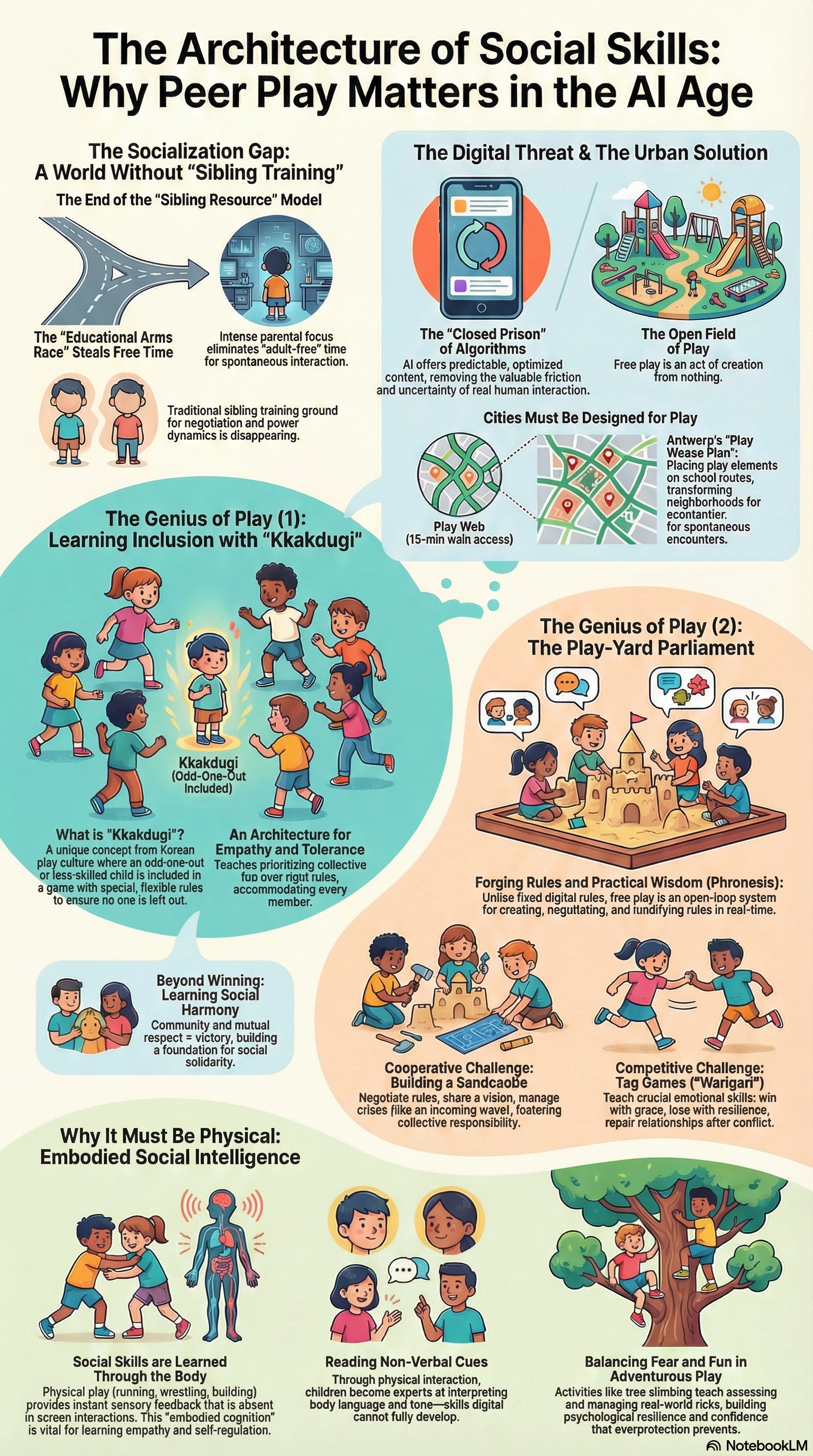
1.1. The Disappearance of the 'Sibling Resource' Model While modern civilization has achieved unprecedented material abundance, it is rapidly dismantling the traditional ecosystem that supported children's social development. In particular, the rise of the nuclear family and the increase in single-child households due to low fertility rates are extinguishing the "sibling relationship," which served as the child's first microcosm of society. In the past, children corrected their egocentric thinking—formed under their parents' unconditional love—through inevitable collisions with siblings, naturally acquiring skills in conflict and reconciliation. Today’s children enter society without this natural training ground, experiencing a "socialization lag" where the critical period for learning sociality is delayed.
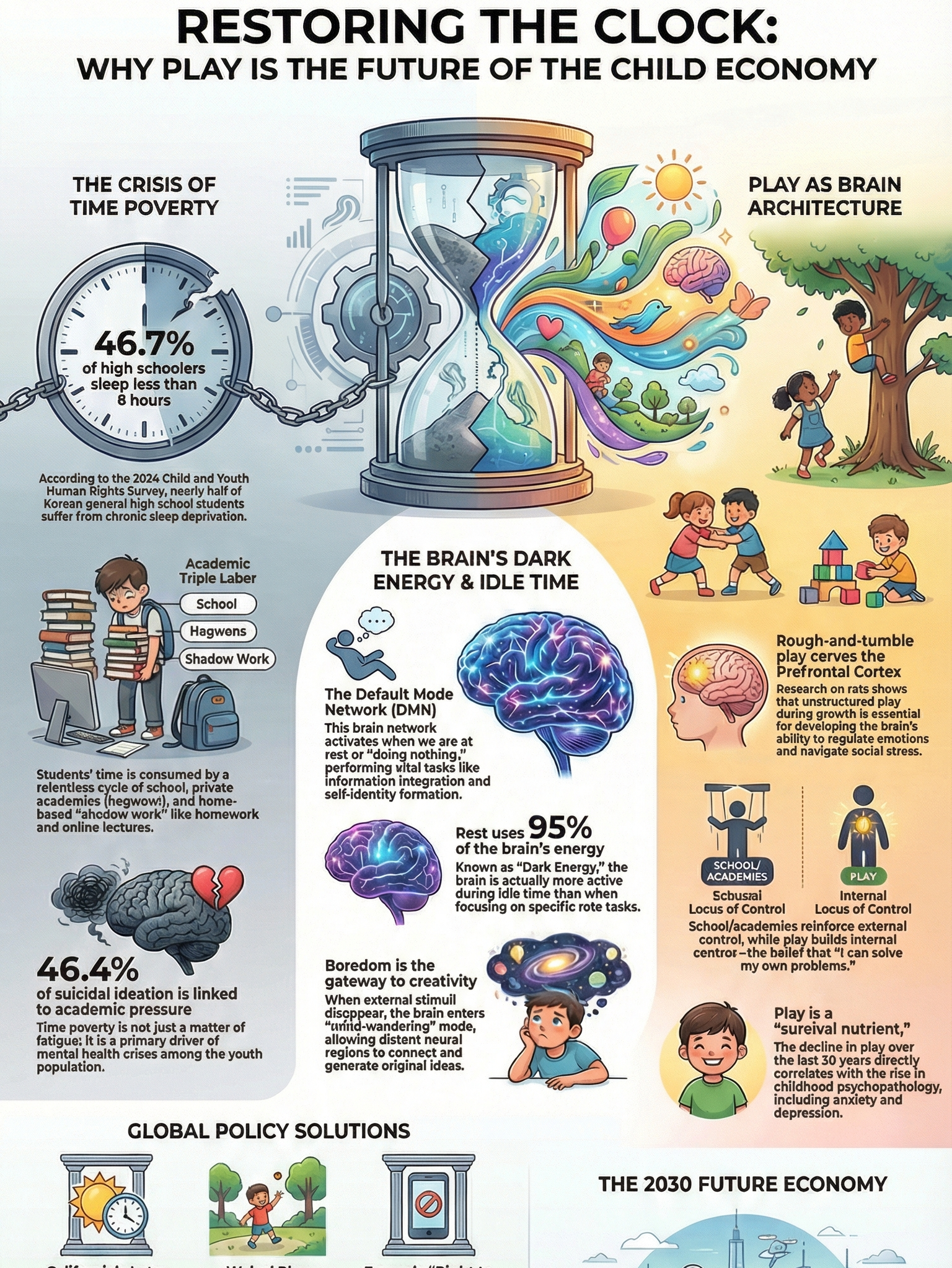
1.2. The Educational Arms Race and the Deprivation of Play Low fertility has spawned a social phenomenon of "maximizing investment per child." The "Educational Arms Race" among parents has filled children's daily schedules with structured learning programs, stripping them of "time without adults."
Fertility Rate∝Social Comparison Motives+Parental Investment Time1
As the motive for social comparison intensifies, parents confine children in structured environments, blocking opportunities for spontaneous socialization offered by Unstructured Play. Therefore, it is essential to plan environments where play can unfold in all areas of public life outside of kindergarten, allowing social skills to be learned frequently.
II. The Aesthetics of 'Kkakdugi': The Architecture of Inclusion and Tolerance
2.1. The Essence of Korean Play Culture: The Kkakdugi System "Kkakdugi" found in traditional Korean play culture is a unique social device that transcends modern competitive logic. When the number of players is uneven or a younger sibling has significantly lower physical abilities, children include them as a "Kkakdugi" instead of excluding them. This grants a kind of "immunity privilege," allowing them to belong to both teams or avoid penalties for mistakes.
• Spirit of Sangsaeng (Coexistence): Based on the communal agreement that "we do not abandon the weak," aiming for reciprocal relationships without exclusion.
• Etymological Symbolism: Just as radish scraps are not thrown away but made into radish kimchi (Kkakdugi), it instills the perception that imperfect beings are essential parts of the community.
2.2. Acquiring Relationship Judgment Skills Through Tolerance By choosing to include younger siblings at the expense of game efficiency, children learn high-level social skills:
• Situational Tolerance: Understanding that a younger sibling's rule violation is not intentional and learning to accommodate them without disrupting the flow of play.
• Flexible Rule Adjustment: Realizing that rules are not fixed truths but adjustable for communal enjoyment by modifying them on the fly for the Kkakdugi.
• Shared Responsibility: Sharing responsibility when the Kkakdugi makes a mistake or celebrating their small contributions as a collective achievement.
III. The Manifestation of Phronesis: The Art of Rule-Making and Negotiation
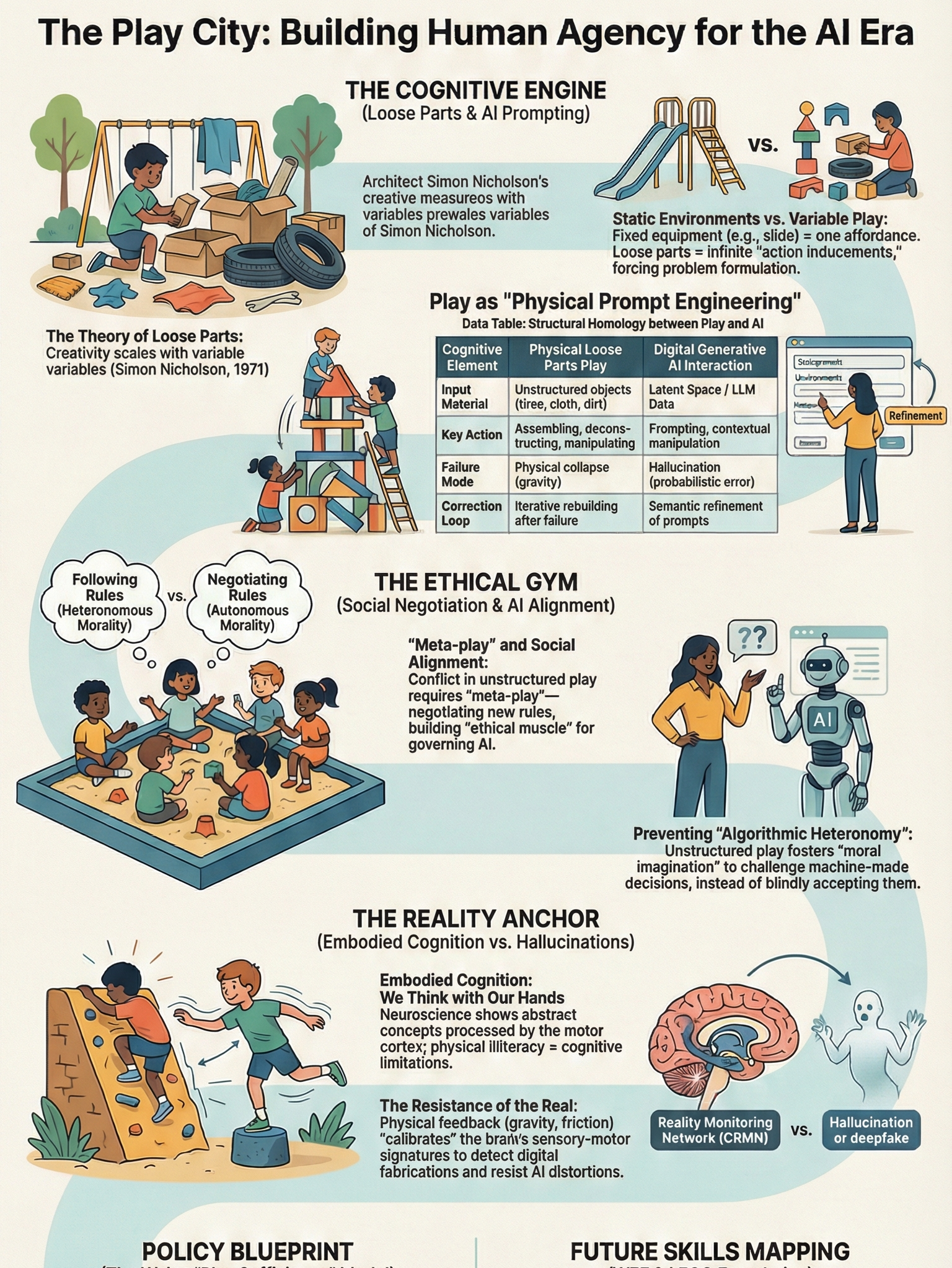
3.1. Practical Judgment Beyond Algorithmic Rules Aristotle's "Phronesis" (Practical Wisdom) is the intellectual virtue of making the best choice in concrete and variable situations. Children's play is where this Phronesis is most dramatically manifested. While AI executes fixed rules based on pre-input algorithms, children create, negotiate, and modify rules themselves on the playground.
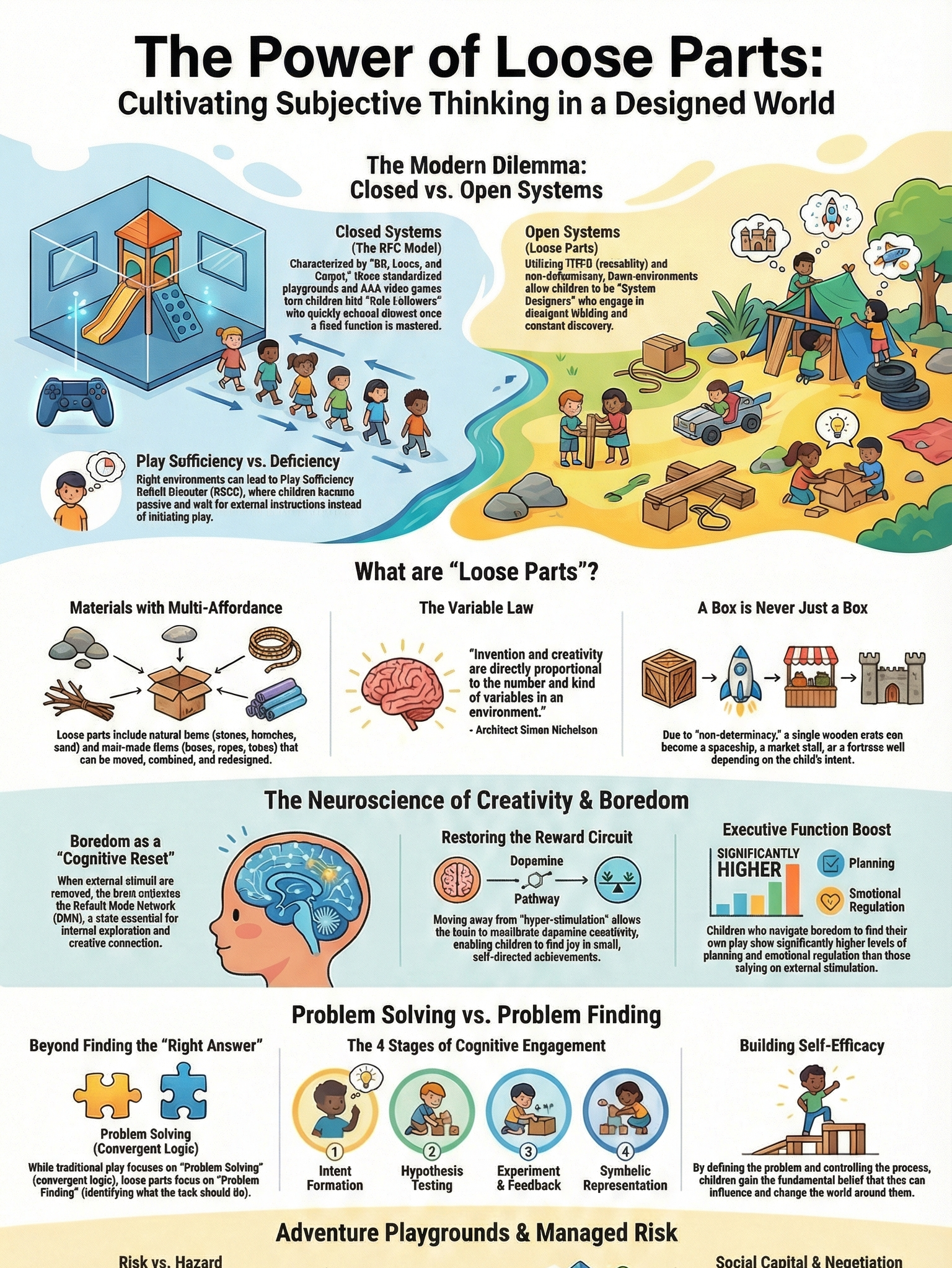
• Open-loop Structure: Unlike digital games that operate within a closed structure set by designers, free play has an open structure where children hold the initiative.
• Situational Ethics: In concrete situations like "How far can the seawater come before we stop building the sandcastle?", children present opinions, debate, and reach a consensus.
3.2. Large-Scale Projects: Sandcastles and Shared Responsibility Cooperative activities like building sandcastles teach children to regulate individual desires for a "common goal." Through role division (shoveling, carrying water) and dealing with unexpected collapses, children form an attitude of shared responsibility.
• Shared Vision: Setting a common goal through discussion.
• Crisis Management: Instead of blaming someone when waves hit the castle, they join forces for immediate recovery.
3.3. Competitive Play: Attitudes toward Winning and Losing Games with clear winners and losers, like "Warigari," are harsh but beneficial classrooms that teach children to manage frustration and temper the joy of victory.
• Emotional Recovery: The process of returning from being fierce competitors to close friends after the game is the pinnacle of childhood sociality. Children activate an "Architecture of Reconciliation" to repair relationships through jokes or proposals like "One more round?"
IV. Embodied Cognition: Why It Must Be Physical Activity
4.1. Social Intelligence Learned Through the Body Interactions via digital screens are abstract experiences devoid of physical involvement. In contrast, play involving physical activity provides "Embodied Cognition," where the brain, body, and environment combine dynamically. Sensory data obtained from pushing and pulling peers cultivates the ability to empathize with others' pain and regulate one's own strength.
• Sensory-Motor Feedback: Immediately recognizing the physical impact of one's movements on others.
• Non-Verbal Communication: Precisely grasping others' emotional states through expressions, gestures, and breathing.
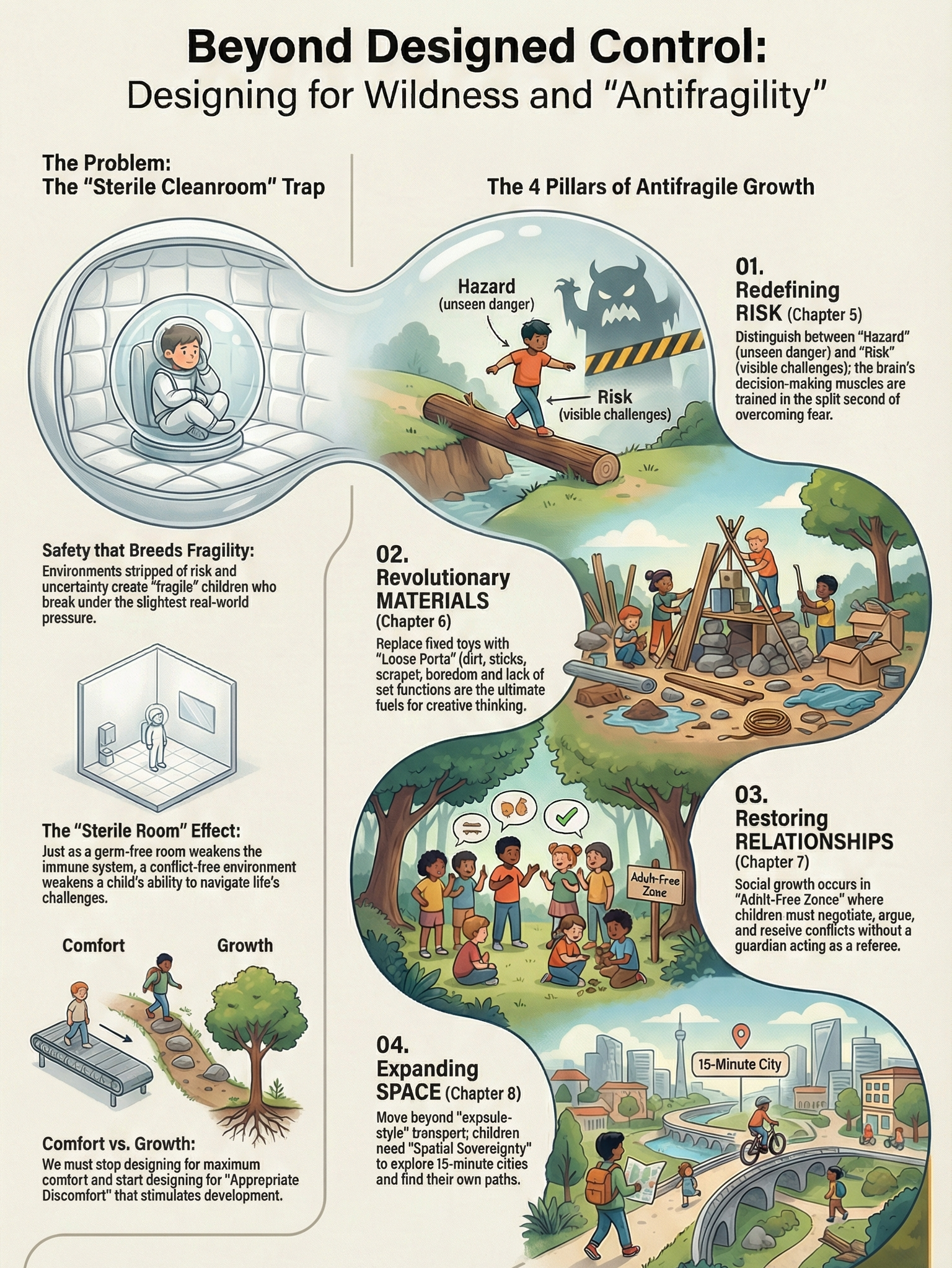
4.2. Adventurous Play and the Balance of 'Fear-Funny' Adventurous play, such as climbing trees, provides opportunities to be exposed to "Controlled Risk." Children learn to sublimate fear into pleasure, which leads to psychological resilience in adulthood. If adults intervene saying, "It's dangerous, don't do it," children are deprived of the opportunity to judge risks and explore their limits.
V. The Pitfalls of Digital Parenting and Humanity AI Cannot Teach
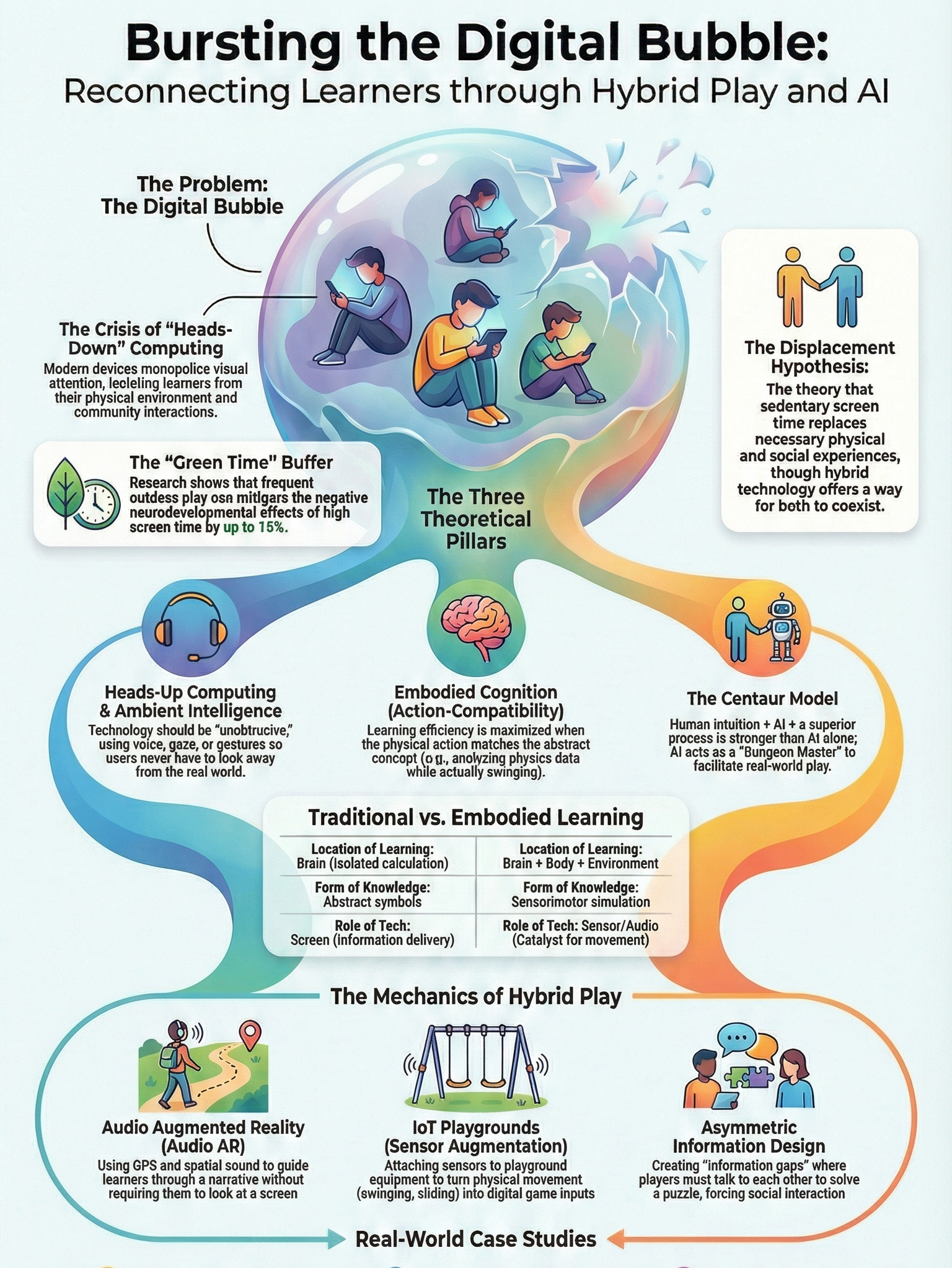
5.1. Algorithms as a 'Closed Prison' While many parents provide smart devices expecting educational effects, this forms a "Closed Loop" that severely undermines a child's autonomy. AI algorithms predict reactions to provide optimized content, removing the "Value of Uncertainty" experienced when colliding with others.
• Designed Initiative vs. Voluntary Initiative: Selection in digital games is choosing one of the options prepared by the designer, whereas choice in free play is creation from nothing (ex nihilo).
• Acceleration of Social Isolation: The moment a tablet is handed over, the child enters a "Digital Cocoon" severed from surroundings, blocking the practice of human interaction.
5.2. Persuasive Design and Dopamine Addiction Digital platforms use "Persuasive Design" to capture attention. Flashy graphics and immediate rewards weaken intrinsic motivation and make children reactive only to external stimuli.
Engagement=Algorithm Bias×Instant Gratification Loop
Conversely, the rewards of real play come from social and emotional satisfaction, such as "My friend acknowledged me." Children who fail to develop this internal reward system cannot feel the subtle joy of relationships and seek only stronger stimuli.
VI. Designing Urban Spaces for the Architecture of Social Negotiation
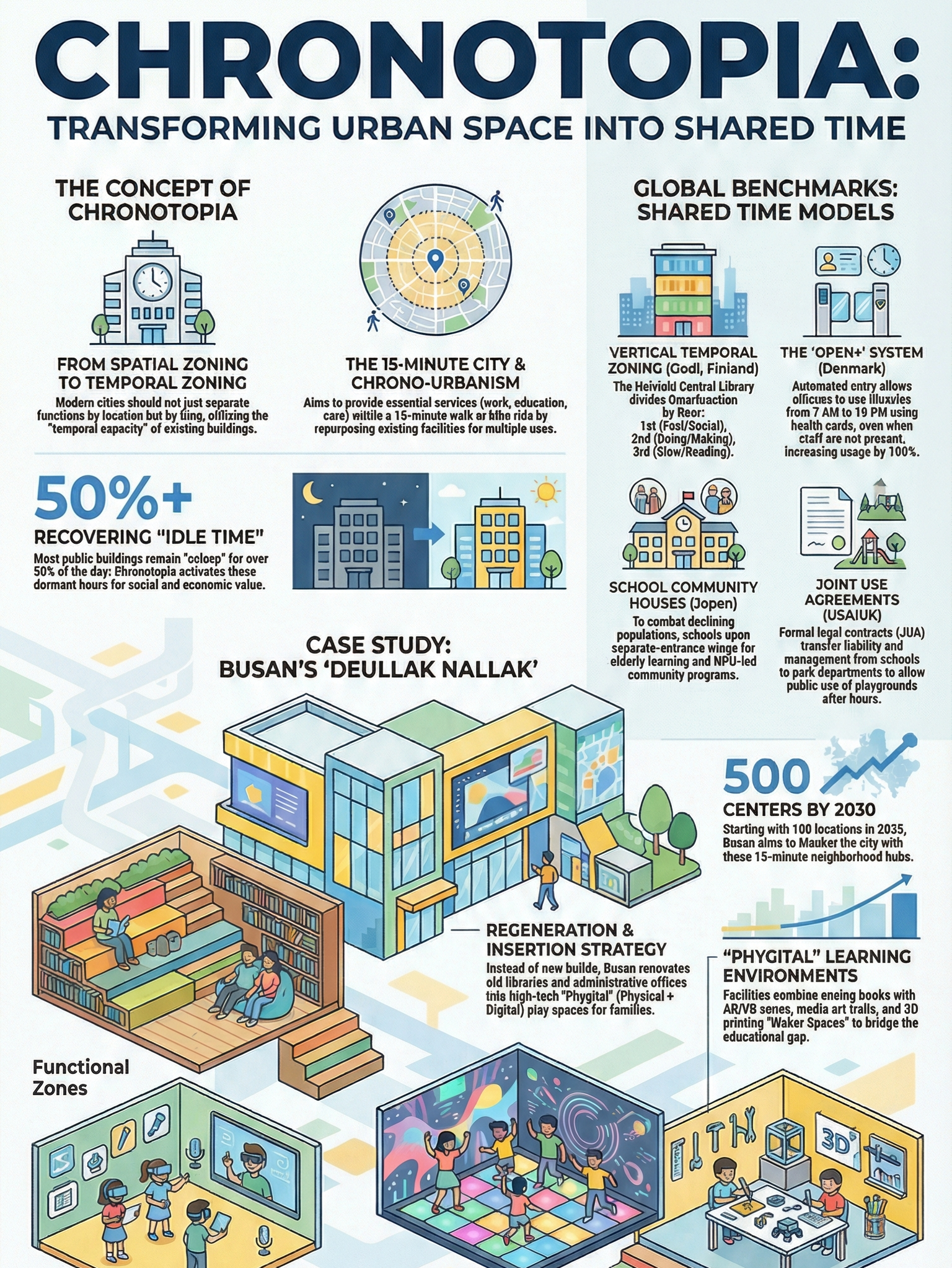
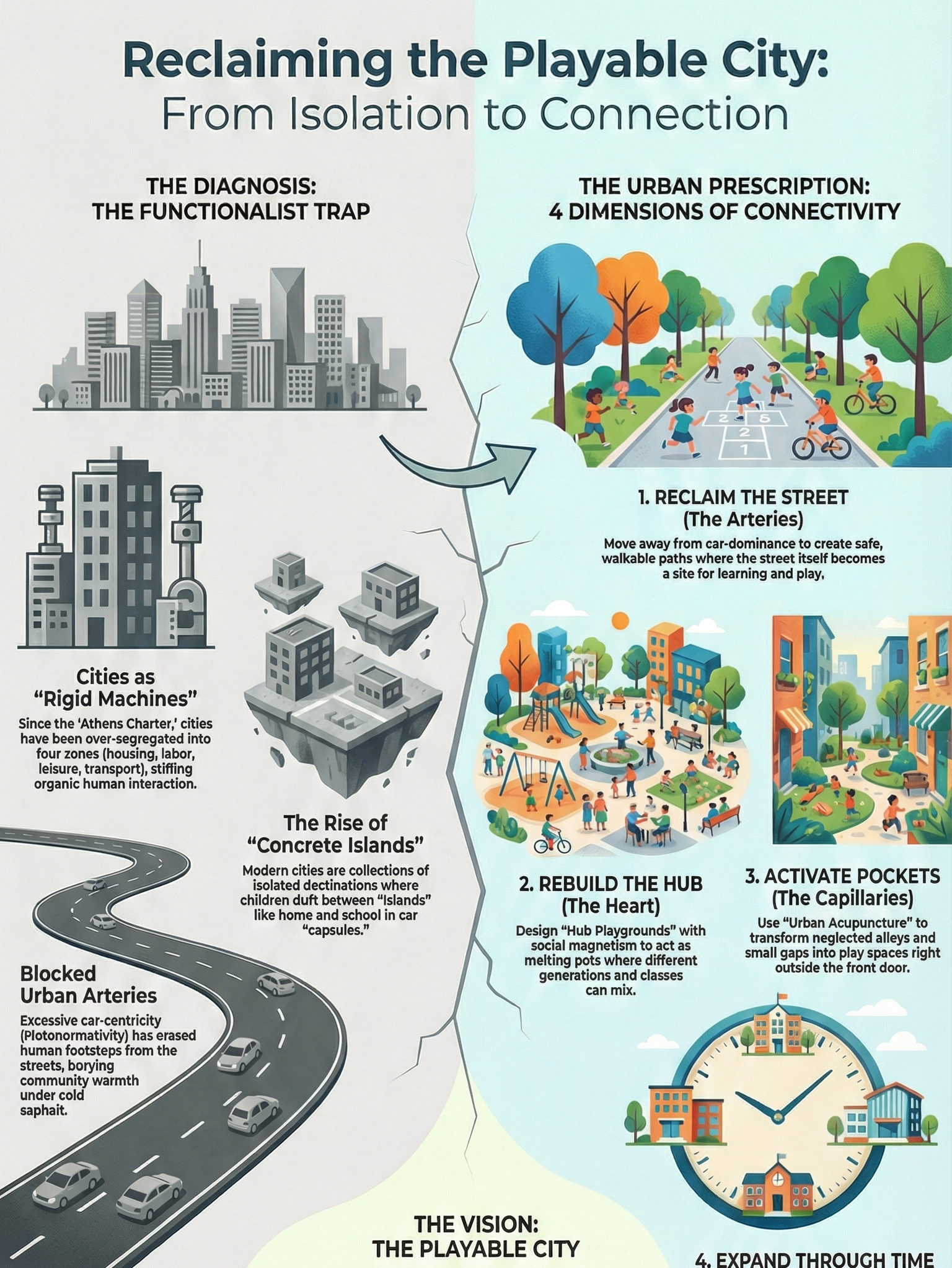
6.1. 15-Minute Cities and Building Play Networks As the number of children decreases, the "opportunity" to meet peers has itself become a resource. Therefore, an "Architecture of Social Negotiation" that guarantees children's right to play must be reflected from the urban planning stage.
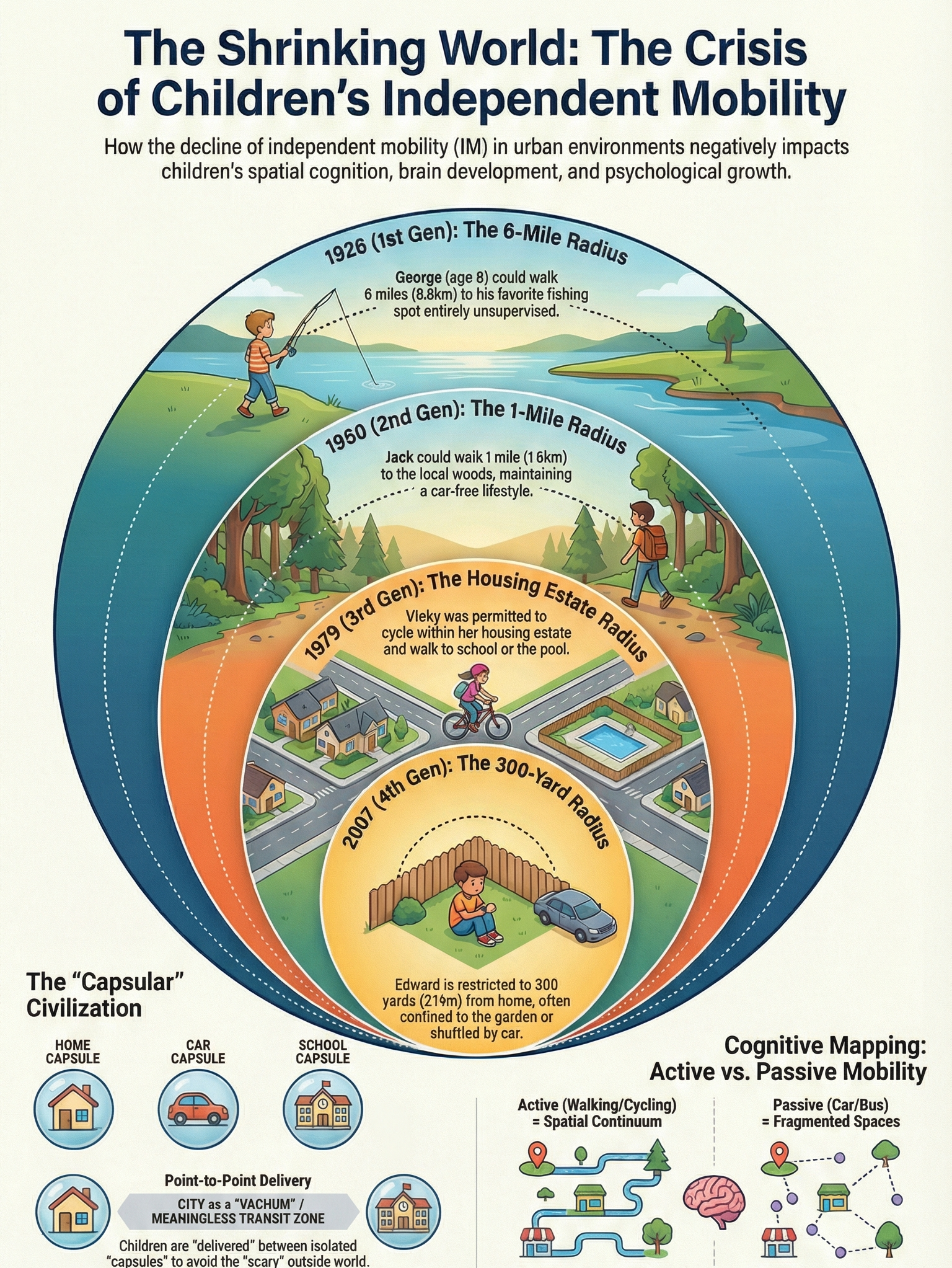
• Antwerp's 'Play Web' (Speelweefselplan): Analyzing children's movement paths to place play stimulus elements (logs, tunnels) on routes from home to school/parks. This strengthens Independent Mobility (IM), creating an environment where friends can meet without adults.
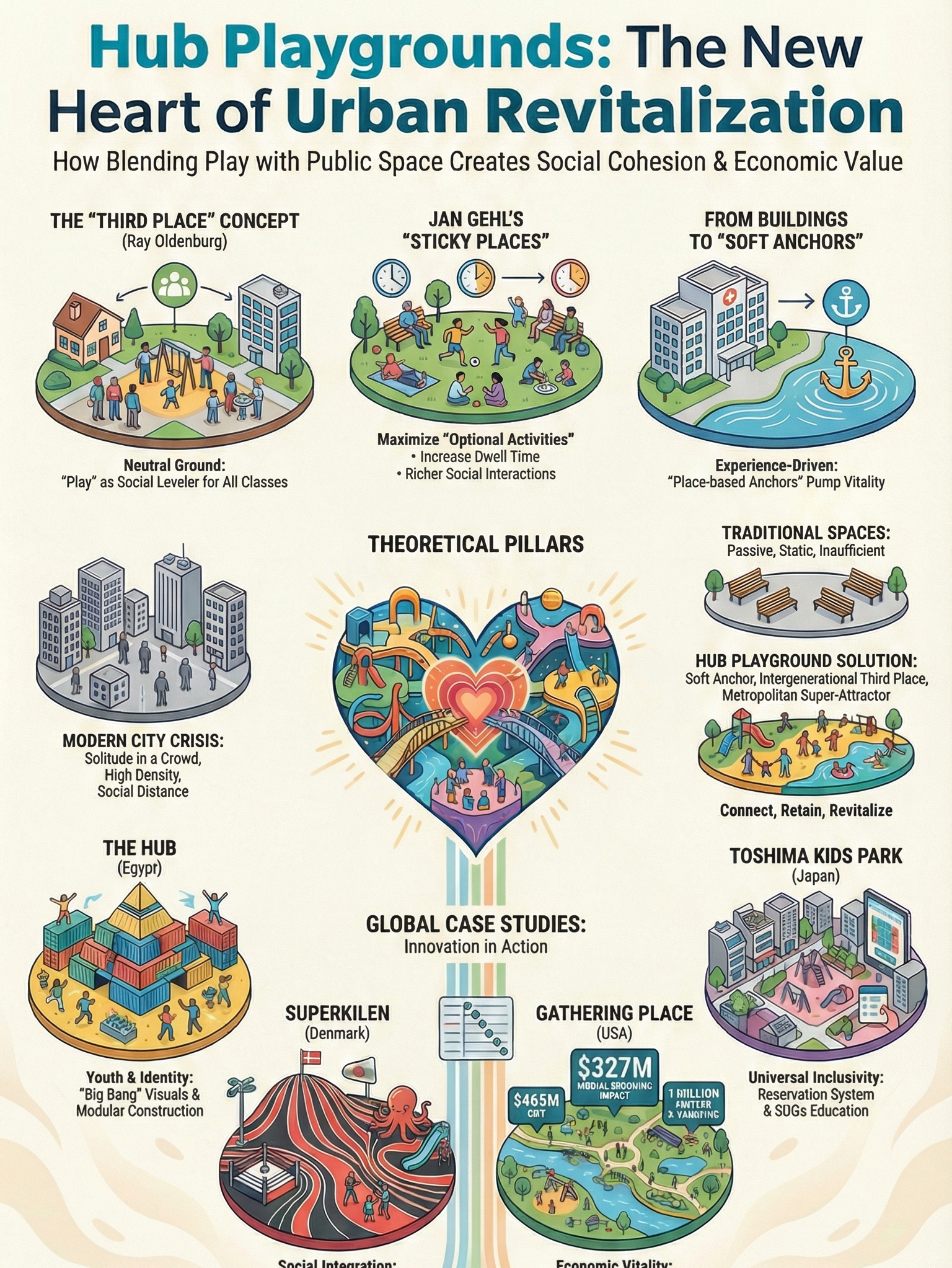
6.2. Play-ification of Public Spaces Outside Schools Streets and plazas beyond the fences of kindergartens or schools must become playgrounds. Like Barcelona's "Superblocks," limiting vehicle traffic and returning roads to children and pedestrians serves as a powerful tool to revitalize communal play.
• Spatial Proximity: Shortening distances between play spaces and connecting safe pedestrian paths increases the frequency of voluntary meetings.
• Social Safety Net: Open designs where the eyes of local residents rest mitigate "Helicopter Parenting."
VII. Conclusion: Free Play as the Last Bastion of Humanity
Peer play is not merely a way to pass time but a process of cultivating the highest-level intelligence required for citizens of future society. The experience of breaking out of the comfortable shield of parental love to collide with peers who have entirely different backgrounds and desires destroys childhood egocentrism and erects an "Architecture of Cooperation" in its place.
The social inclusivity shown in the Kkakdugi culture, the shared responsibility learned while building sandcastles, and the art of reconciliation following fierce competition are realms that sophisticated AI simulations can never reach. AI attempts to "remove" or "optimize" conflict, but humans learn "how to live together" with conflict through play.
Therefore, as the number of children decreases, modern society must build even stronger play infrastructure. We must return empty time and space, free from adult intervention, to children. Letting them create their own rules, allow Kkakdugi, and judge relationships there is the greatest design for raising human-like children in an era of technological omnipotence. The sweat shed on the playground and the heated debates over rules will become the cornerstone of the most solid social consensus sustaining future society.
제7장. 어른이 없는 세계: '싸움'이라는 사회적 수업
1. 형제의 소멸과 '수직적' 아이들
인류 역사상 가장 오랫동안 아이들의 사회성을 길러준 '최초의 학교'는 바로 형제자매 관계였다. 부모의 사랑을 독차지하기 위해 경쟁하고, 장난감을 두고 다투며, 힘의 균형을 맞추는 과정에서 아이들은 타협의 기술을 본능적으로 익혔다.
그러나 저출산과 핵가족화로 인해 이 '가장 작은 사회'가 붕괴했다. 오늘날 많은 아이는 외동이거나, 형제와 놀 시간이 부족하다. 더 큰 문제는 그 빈자리를 또래 친구가 아닌, 학원 선생님이나 부모 같은 '어른'들이 채우고 있다는 점이다.
수평적인 관계에서 부딪히며 크는 대신, 수직적인 관계에서 보호받으며 자란 아이들은 **'갈등을 해결하는 법'**이 아니라 **'어른에게 호소하는 법'**만을 배운다. 이는 사회성 발달에 있어 치명적인 결핍을 낳는다.
2. 복종(Compliance)인가, 협상(Negotiation)인가
심리학자 장 피아제(Jean Piaget)는 도덕성을 두 가지 차원으로 구분했다. 하나는 어른이 정한 규칙을 따르는 **'타율적 도덕성'**이고, 다른 하나는 또래와의 상호작용 속에서 형성되는 **'자율적 도덕성'**이다.
어른이 주도하는 놀이(예: 축구 교실, 보드게임 수업)에서 규칙은 절대적이다. 아이들의 목표는 코치의 호루라기 소리에 맞춰 규칙을 준수하는 것, 즉 **'복종(Compliance)'**이다.
반면, 어른이 없는 골목길 축구에서는 규칙이 유동적이다. "골대는 여기까지 하자", "핸들링 반칙은 세 번까지 봐주자"라며 아이들은 끊임없이 규칙을 수정하고 합의한다. 이것이 바로 **'협상(Negotiation)'**이다. 나의 욕구와 타인의 욕구가 충돌할 때, 파국을 막기 위해 서로 한 발씩 양보하는 이 과정이야말로 민주주의의 원형이자 진정한 사회적 지능의 출발점이다.
3. 갈등의 미학: 시끄러운 놀이터가 민주주의를 만든다
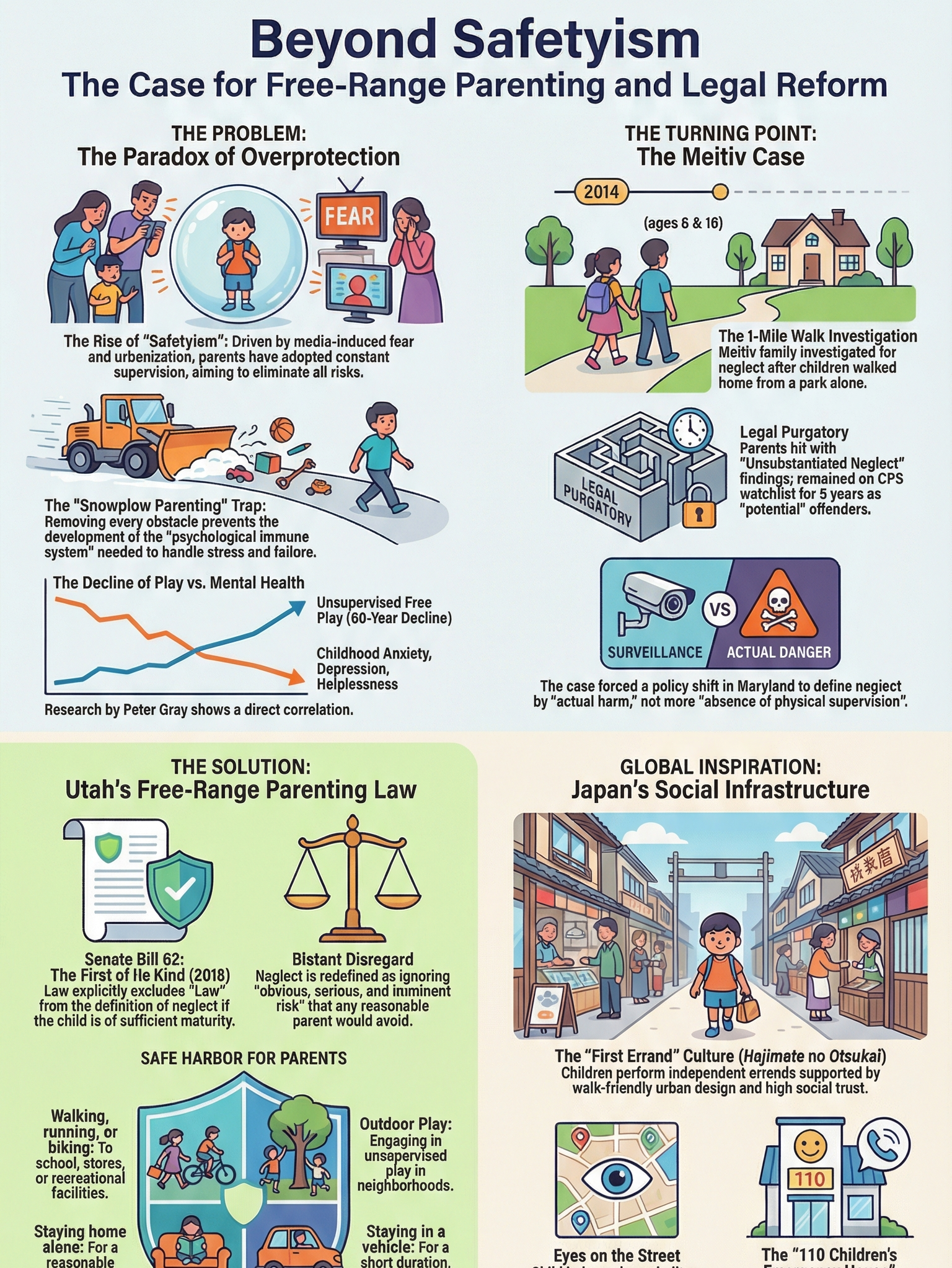
현대 부모들은 아이들의 싸움을 '문제 상황'으로 인식하고 즉시 개입하여 "사이좋게 지내라"며 중재에 나선다. 하지만 이는 아이들이 성장할 기회를 뺏는 행위다.
놀이 이론가 피터 그레이(Peter Gray)가 지적했듯, 자유 놀이의 본질은 **'그만두고 싶으면 언제든 그만둘 수 있다'**는 점에 있다. 아이가 너무 제멋대로 굴면 친구들은 떠나버린다. 따라서 아이는 놀이를 지속하기 위해 자신의 나르시시즘을 억제하고 타인의 기분을 살피는 법을 배워야 한다.
이 치열한 눈치 싸움과 갈등 조정 과정이 뇌의 전두엽을 자극한다. 놀이터가 시끄럽고, 아이들이 얼굴을 붉히며 언성을 높이는 그 순간이 사실은 가장 고도화된 사회적 훈련이 이루어지는 때다. 갈등 없는 평화로운 놀이터는 죽은 공간이나 다름없다.
4. 공간의 해법: 자동차를 몰아낸 '플레이 스트리트'
그렇다면 어떻게 아이들에게 '협상의 공간'을 돌려줄 것인가? 벨기에 등 유럽에서 확산되고 있는 **'플레이 스트리트(Play Streets)'**는 훌륭한 대안이다.
이 프로젝트의 핵심은 거창한 놀이터를 짓는 것이 아니다. 특정 시간 동안 거주자 우선 주차 구역에서 자동차를 몰아내고, 그 공간을 아이들에게 내어주는 것이다. 아스팔트 위에 분필로 그림을 그리고, 자전거를 타고, 벼룩시장을 여는 동안 거리는 단순한 이동 통로에서 **'사회적 교류의 장'**으로 변모한다.
연구 결과, 플레이 스트리트는 아동의 신체 활동을 증가시킬 뿐만 아니라, 이웃 간의 대화를 복원하고 지역 사회의 신뢰도(Social Capital)를 높이는 것으로 나타났다. 닫힌 놀이터가 아닌, 삶의 현장인 거리에서 아이들은 다양한 연령대의 이웃과 마주치며 사회적 관계망을 확장한다.
5. 결론: '친절한 방관'의 지혜
아이들의 사회성은 교과서나 유튜브로 배울 수 있는 지식이 아니다. 그것은 부대끼고, 싸우고, 화해하는 구체적인 경험을 통해서만 체득되는 **'암묵지(Tacit Knowledge)'**다.
이제 어른들은 한 걸음 뒤로 물러서야 한다. 아이들이 갈등을 빚을 때 즉시 심판관으로 나서기보다, 그들이 스스로 해법을 찾을 때까지 기다려주는 **'친절한 방관(Benign Neglect)'**이 필요하다.
어른의 개입이 사라진 공간, 규칙이 정해지지 않은 느슨한 시간, 그리고 기꺼이 싸울 수 있는 자유. 이것이 인공지능 시대에도 대체되지 않을, 인간 고유의 협력 DNA를 깨우는 유일한 열쇠다.
제7장. 사회적 협상의 아키텍처: 또래 놀이가 가르치는 갈등 해결과 협력
서론: 아동기 사회화의 구조적 변천과 놀이의 생태학적 복원
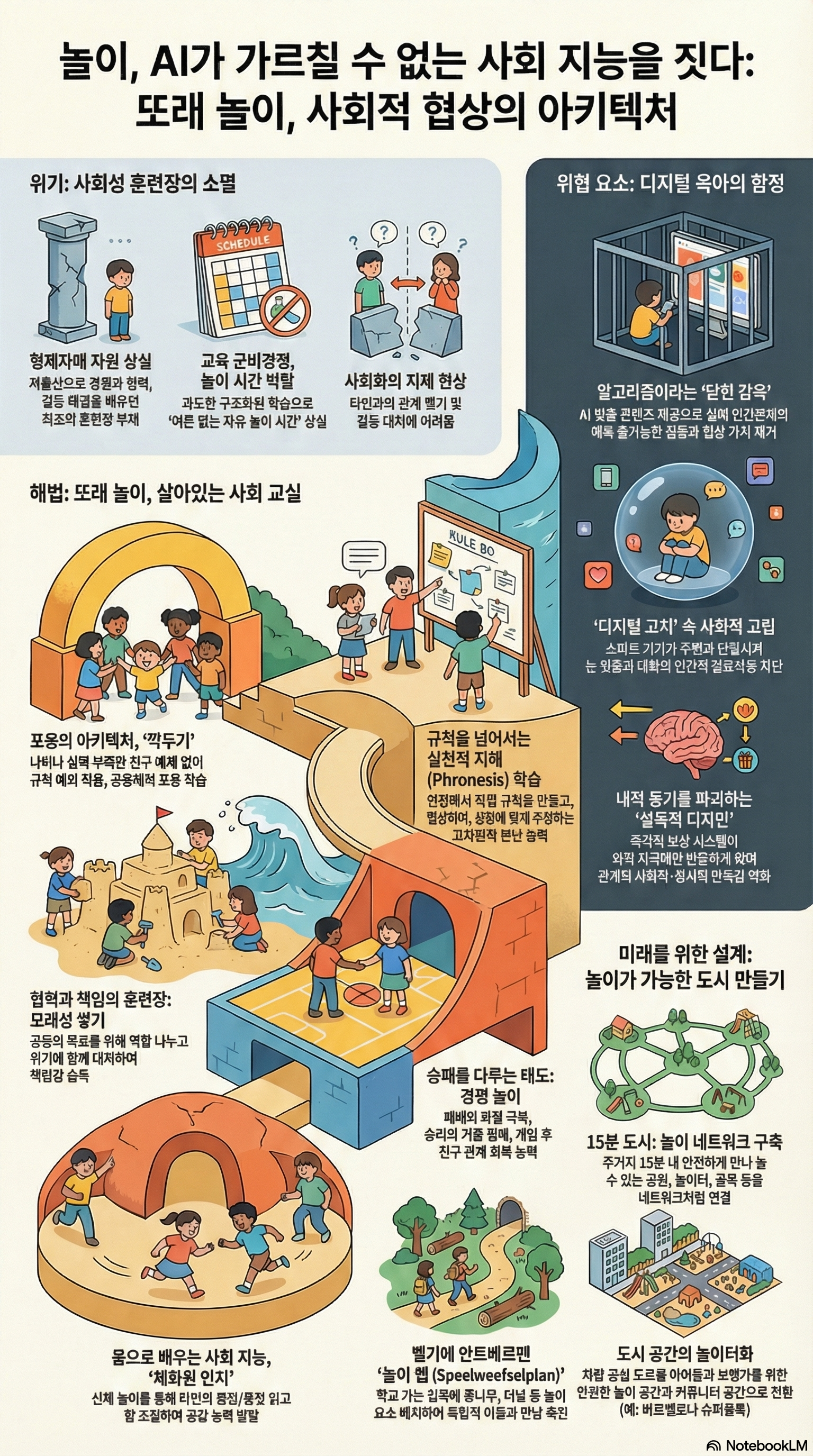
현대 문명은 전례 없는 물질적 풍요와 기술적 진보를 이룩하였으나, 동시에 아동의 사회적 발달을 지탱해 온 전통적인 생태계를 급격히 해체하고 있다. 특히 저출산 기조로 인한 핵가족화와 외동 자녀의 증가는 아동이 최초로 마주하는 소우주였던 '형제 관계'를 소멸시키고 있다.1 과거의 아동은 부모의 무조건적 애정 속에서 형성된 자기중심적 사고를 형제자매라는 필연적 타자와의 충돌을 통해 교정하며, 갈등과 화해의 기술을 자연스럽게 습득하였다.1 그러나 오늘날의 아동은 이러한 자연적 훈련장이 결핍된 채 사회에 진입하며, 그 결과 사회성 학습의 결정적 시기가 지연되는 '사회화의 지체' 현상을 겪고 있다.4
이러한 공백을 메울 수 있는 유일하고도 강력한 대안은 어른의 개입이 배제된 '또래와의 자유 놀이'이다. 자유 놀이는 단순한 유희의 차원을 넘어, 아동이 스스로 규칙을 설계하고 이해관계를 조정하며 공동의 책임을 완수하는 '사회적 협상의 아키텍처'를 구축하는 실전적 과정이다.5 인공지능(AI)과 디지털 알고리즘이 아동의 일상을 잠식하는 시대에, 놀이를 통해 체득되는 인간적 상호작용과 관계 판단 능력은 기계가 결코 대체할 수 없는 인간 고유의 영역으로 남는다.7 본 보고서는 또래 놀이가 가르치는 사회적 기술의 메커니즘을 심층 분석하고, 현대 사회에서 이러한 기술이 모든 곳에서 학습될 수 있도록 보장하는 도시 공학적·교육적 설계 방안을 고찰한다.
제1절. 형제 관계의 소멸과 사회화 메커니즘의 재편
1.1. '형제자매 자원' 모델의 상실과 외동 자녀의 발달 과제
전통적인 발달 심리학에서 형제자매는 단순한 가족 구성원을 넘어 아동의 '사회적 자본(Social Capital)'으로 정의되었다.1 '형제자매 자원' 모델에 따르면, 형제간의 상호작용은 감정 조절 능력과 친화성을 강화하는 필수적인 경로이다.1 형제는 부모의 관심을 공유하고 자원을 배분하며 때로는 권력을 다투는 과정을 통해, 성인기 조직 생활의 기초가 되는 경쟁과 협력의 기술을 전수한다.4
사회화 모델 유형
주요 가설 및 메커니즘
사회적 성취 및 성격적 특징
자원 희석 모델 (Resource Dilution)
자녀 수가 많을수록 부모의 경제적/시간적 자원이 분산되어 개별 자녀의 발달 지원이 감소함.1
외동 자녀가 학업 성취도 및 인지 발달에서 상대적 우위를 점함.1
형제 자원 모델 (Siblings as Resources)
형제와의 상호작용이 사회적 학습의 근간이 되며, 특히 정서적 지지와 갈등 해결 능력을 함양함.1
비외동 자녀가 팀워크, 권력 획득 전략, 협력 지향성에서 우위를 보임.4
외동 고유성 모델 (Only Child Uniqueness)
외동은 첫째이자 막내인 독특한 위치에서 혼자만의 시간을 견디며 자율성과 창의성을 발달시킴.1
친구 관계의 질이나 사회적 수용도에서 형제 있는 아동과 큰 차이가 없음.9
연구에 따르면, 형제가 없는 아동은 부모에 대한 의존도가 높고 갈등 상황에서 성인의 중재를 구하려는 경향이 강한 반면, 형제가 있는 아동은 형제와의 끊임없는 '권력 투쟁'을 통해 스스로 문제를 해결하는 능력을 키운다.4 특히 형이나 누나에게 느끼는 열등감을 극복하거나 어린 동생을 돌보는 경험은 아동이 타인의 관점을 이해하고 관계의 역동을 판단하는 결정적인 기초가 된다.3
1.2. 교육적 군비경쟁과 놀이의 박탈
현대 사회의 저출산은 '자녀 1인당 투자 극대화'라는 사회적 현상을 낳았다.2 부모들 사이에서 발생하는 '교육적 군비경쟁(Educational Arms Race)'은 아동의 일과를 구조화된 학습 프로그램으로 채우게 만들었으며, 이는 아동으로부터 '어른 없는 시간'을 앗아갔다.11
$$\text{Fertility Rate} \propto \frac{1}{\text{Social Comparison Motives} + \text{Parental Investment Time}}$$
위의 수식적 관계에서 알 수 있듯이, 타인과의 비교 동기가 강할수록 부모는 자녀를 구조화된 환경에 가두게 되며, 이는 비구조화된 놀이(Unstructured Play)가 제공하는 자발적 사회화의 기회를 차단한다.12 따라서 유치원 밖 공공 생활의 모든 영역에서 놀이가 펼쳐져야 하며, 그곳에서 수시로 사회적 기술을 배울 수 있는 환경을 계획하는 것이 필수적이다.
제2절. '깍두기'의 미학: 포용과 관용의 아키텍처
2.1. 한국적 놀이 문화의 정수, 깍두기 시스템
한국의 전통 놀이 문화에서 발견되는 '깍두기'는 현대의 엄격한 경쟁 논리를 초월하는 독특한 사회적 장치이다. 놀이 인원이 맞지 않거나 신체적 능력이 현저히 떨어지는 어린 동생이 있을 때, 아이들은 그를 소외시키는 대신 '깍두기'라는 이름으로 놀이에 포함시킨다.15 이는 정식 팀원은 아니지만 모든 팀에 속할 수 있거나 실수를 해도 벌칙을 받지 않는 일종의 '면책 특권'을 부여받은 존재를 의미한다.15
상생(Sangsaeng)의 정신: 깍두기 문화는 '약자를 버리지 않는다'는 공동체적 합의에 기반한다. 이는 한국 특유의 '정(Jeong)' 문화와 맞닿아 있으며, 모든 구성원이 소외 없이 어울리는 상호 호혜적 관계를 지향한다.15
어원적 상징성: 깍두기 김치를 담글 때 모양이 예쁘지 않은 무 조각들도 버리지 않고 함께 버리듯, 완벽하지 않은 존재도 공동체의 필수적인 일부라는 인식을 심어준다.15
2.2. 관용을 통한 관계 판단 기술의 습득
또래들과 놀러 나갈 때 어린 동생을 맡아서 함께 나온 아이들은 놀이의 효율성을 희생하더라도 동생을 놀이에 끼워주는 선택을 한다. 이 과정에서 아이들은 다음과 같은 고도의 사회적 기술을 학습한다.
상황적 관용: 어린 동생이 규칙을 어기더라도 그것이 고의가 아님을 이해하고, 놀이의 흐름을 깨지 않으면서도 그를 배려하는 법을 익힌다.15
유연한 규칙 조정: 깍두기를 위해 규칙을 즉석에서 수정하거나 예외를 두는 과정에서, 규칙이란 고정불변의 진리가 아니라 공동의 즐거움을 위해 조정 가능한 것임을 깨닫는다.6
공동의 책임: 깍두기가 실수를 했을 때 그 팀 전체가 책임을 나누거나, 반대로 깍두기의 작은 공헌을 크게 축하하며 집단적 성취감을 공유한다.17
깍두기 시스템의 구성 요소
사회적 학습 영역
내면화되는 가치
비완전성 수용
정육면체가 아닌 무 조각도 깍두기가 되듯 타인의 부족함을 수용함.16
인간 존중, 다양성 인정
조건 없는 포용
팀 인원이 맞지 않아도 배제하지 않고 함께 노는 길을 찾음.15
사회적 포용력, 환대
놀이의 신명성 우선
승패라는 결과보다 놀이 자체의 흥겨움과 대동성을 우선시함.20
공동체 의식, 즐거움의 공유
이러한 경험은 아동이 훗날 성인이 되었을 때 경쟁 지향적인 스포츠맨십을 넘어, 소외된 이들을 공동체 안으로 끌어안는 '사회적 연대'의 기초 체력을 형성하게 한다.16
제3절. 실천적 지혜(Phronesis)의 발현: 규칙 제정과 협상의 기술
3.1. 알고리즘적 규칙을 넘어서는 실천적 판단
아리스토텔레스가 제시한 '프로네시스(Phronesis, 실천적 지혜)'는 구체적이고 가변적인 상황에서 최선의 선택을 내리는 지적 덕목이다.21 아이들의 놀이는 이러한 프로네시스가 가장 극적으로 발현되는 장이다. 인공지능이 사전에 입력된 알고리즘에 따라 고정된 규칙을 수행한다면, 아이들은 놀이의 현장에서 규칙 자체를 창조하고 협상하며 수정한다.6
오픈 루프(Open-loop) 구조: 디지털 게임은 설계자가 정한 닫힌 구조 내에서 작동하지만, 자유 놀이는 아동이 주도권을 쥐고 규칙을 끊임없이 변형하는 열린 구조를 가진다.7
상황적 윤리: "모래성을 쌓을 때 바닷물이 어디까지 들어오면 중단할 것인가?"와 같은 구체적인 상황에서 아이들은 각자의 의견을 제시하고 토론하며 합의에 도달한다.21
3.2. 대규모 프로젝트: 모래성 짓기와 공동의 책임
모래성 짓기와 같은 협력적 활동은 아동에게 '공동의 목표'를 위해 개인의 욕구를 조절하는 법을 가르친다. 성을 쌓는 과정에서 발생하는 역할 분담(삽질, 물 나르기, 장식하기)과 예상치 못한 붕괴 상황은 아동이 공동의 책임을 지는 태도를 형성하게 한다.17
비전 공유: 어떤 형태의 성을 쌓을지 토론하며 공통의 목표를 설정한다.
역할 협상: 각자의 능력과 선호에 따라 직무를 배분하고, 갈등 발생 시 조정을 거친다.25
위기 대처: 파도가 성을 덮칠 때 누구의 탓을 하기보다 즉각적인 복구 작업을 위해 힘을 합친다.26
이 과정에서 아이들은 단순히 과업을 수행하는 기술(Techne)을 넘어, 타인의 감정을 읽고 공동체의 결속을 유지하는 '관계 판단 기술'을 체득한다.18
3.3. 경쟁적 놀이: '와리가리'와 승패의 태도
'와리가리'와 같이 승패가 명확한 놀이는 아동에게 좌절을 다스리고 승리의 기쁨을 절제하는 법을 가르치는 가혹하지만 유익한 교실이다.29
승리자의 태도: 패배한 친구를 조롱하지 않고 다음 게임을 기약하는 '품위 있는 승리'를 배운다.
패배자의 회복력: 자신의 한계를 인정하고 감정적인 동요를 최소화하며 다시 놀이에 참여하는 '건강한 패배'를 익힌다.28
정서적 복구(Emotional Recovery): 게임이 끝난 후, 치열하게 싸웠던 경쟁자에서 다시 친한 친구로 돌아가는 과정은 아동기 사회성의 정점이다. 아이들은 "한 판 더 할래?"라는 제안이나 농담을 통해 서먹해진 분위기를 깨고 관계를 복구하는 '화해의 아키텍처'를 가동한다.31
제4절. 체화된 인지(Embodied Cognition): 왜 신체 활동이어야 하는가
4.1. 몸으로 배우는 사회적 지능
디지털 화면을 통한 상호작용은 신체의 개입이 배제된 추상적인 경험이다.7 반면 신체 활동을 동반한 놀이는 뇌와 몸, 그리고 환경이 역동적으로 결합하는 '체화된 인지'를 제공한다.34 아이들이 서로 밀치고 당기며 뛰노는 과정에서 얻는 감각 데이터는 타인의 고통을 공감하고 자신의 힘을 조절하는 능력을 길러준다.36
신체 놀이의 기제
발달적 기여
관련 이론 및 근거
감각-운동 피드백
자신의 움직임이 타인에게 미치는 신체적 영향을 즉각적으로 인지함.37
피아제의 감각운동기 발달 37
비언어적 커뮤니케이션
표정, 몸짓, 숨소리를 통해 타인의 감정 상태를 정밀하게 파악함.7
거울 뉴런 시스템의 활성화 38
생리적 각성 조절
숨이 차고 심장이 뛰는 신체적 흥분을 사회적으로 수용 가능한 수준으로 조절함.39
정서 조절 능력의 강화 28
4.2. 모험적 놀이와 '공포-재미'의 균형
나무에 오르거나 높은 곳에서 뛰어내리는 모험적 놀이는 아동에게 '통제할 수 있는 위험'에 노출되는 기회를 제공한다.39 아이들은 이러한 경험을 통해 공포를 즐거움으로 승화시키는 법을 배우며, 이는 성인기의 심리적 회복력(Resilience)으로 이어진다.40 만약 어른들이 "위험해, 하지 마"라며 모든 개입을 한다면, 아동은 스스로 위험을 판단하고 자신의 한계를 탐색할 기회를 박탈당하게 된다.14
제5절. 디지털 육아의 함정과 AI가 가르칠 수 없는 인간성
5.1. 알고리즘이라는 '닫힌 감옥'
많은 부모가 교육적 효과를 기대하며 스마트 기기를 제공하지만, 이는 아동의 자율성을 심각하게 훼손하는 '폐쇄형 루프'를 형성한다.7 AI 알고리즘은 아동의 반응을 예측하여 최적화된 콘텐츠를 제공하지만, 이는 아동이 타인과 부딪히며 겪어야 할 '불확실성의 가치'를 제거한다.38
설계된 주도성 vs. 자발적 주도성: 디지털 게임 내에서의 선택은 설계자가 준비한 보기 중 하나를 고르는 것이지만, 자유 놀이에서의 선택은 아무것도 없는 상태에서 무언가를 만들어내는 무(無)에서의 창조이다.23
사회적 고립의 가속화: 태블릿을 쥐어주는 순간 아동은 주변 친구나 부모로부터 단절된 '디지털 고치(Cocoon)' 속으로 들어간다.7 이는 타인과 눈을 맞추고 대화하며 합의를 끌어내는 인간적 상호작용의 연습을 차단한다.38
5.2. 설득적 디자인과 도파민 중독
디지털 플랫폼은 아동의 주의력을 붙잡아두기 위해 '설득적 디자인(Persuasive Design)'을 활용한다.7 화려한 그래픽과 즉각적인 보상은 아동의 내적 동기를 약화시키고 외적 자극에만 반응하게 만든다.7
$$\text{Engagement} = \text{Algorithm Bias} \times \text{Instant Gratification Loop}$$
반면 실제 놀이의 보상은 "친구가 나를 인정해 주었다" 혹은 "우리가 힘을 합쳐 성을 완성했다"와 같은 사회적·정서적 만족감에서 온다.7 이러한 내적 보상 시스템이 발달하지 못한 아동은 타인과의 관계에서 오는 은은한 즐거움을 느끼지 못하고 더 강력한 자극만을 추구하게 된다.7
제6절. 사회적 협상의 아키텍처를 위한 도시 공간 설계
6.1. 15분 도시와 놀이 네트워크의 구축
아이들이 줄어드는 현대 사회에서 또래를 만날 수 있는 '기회' 자체가 하나의 자원이 되었다. 따라서 도시 계획 단계에서부터 아동의 놀이권을 보장하는 '사회적 협상의 아키텍처'가 반영되어야 한다.45
15분 라이프 서클: 주거지에서 도보 15분 이내에 안전하게 놀 수 있는 공공 공간이 네트워크화되어야 한다.45
안트베르펜의 '놀이 웹(Speelweefselplan)': 벨기에 안트베르펜은 아동의 이동 경로를 분석하여 집에서 학교, 공원까지 이어지는 경로에 놀이 자극 요소(통나무, 터널, 안전한 건널목)를 배치했다.47 이는 아동의 독립적 이동성(Independent Mobility)을 강화하여 어른 없이도 친구를 만날 수 있는 환경을 조성한다.47
6.2. 학교 밖 공공 장소의 놀이터화
유치원이나 학교의 울타리를 넘어 길거리와 광장이 놀이터가 되어야 한다. 바르셀로나의 '슈퍼블록(Superblocks)' 사례처럼 차량 통행을 제한하고 도로를 아동과 보행자에게 돌려주는 시도는 공동체적 놀이를 활성화하는 강력한 도구가 된다.47
도시 설계 지표
구현 방식 및 구체적 요소
기대 효과
공간적 근접성
놀이 공간 간의 거리를 단축하고 안전한 보행로를 연결함.45
아동의 자발적 만남 빈도 증가 48
환경적 자극
자연 재료(물, 모래, 나무)와 가변적 구조물 배치.51
창의적 놀이 및 규칙 제정 활성화 5
사회적 안전망
지역 주민의 시선이 머무는 개방형 디자인.46
과잉 보호(Helicopter Parenting) 완화 14
이러한 물리적 아키텍처는 아이들이 유치원 밖 공공 생활에서 항시 놀이를 펼칠 수 있게 하며, 수시로 사회적 협상의 기술을 배울 수 있는 기반을 제공한다.46
제7절. 결론: 인간다움의 마지막 보루로서의 자유 놀이
본 보고서를 통해 분석한 바와 같이, 또래 놀이는 단순한 시간을 보내는 행위가 아니라 미래 사회의 시민으로서 필요한 가장 고차원적인 지능을 배양하는 과정이다.21 부모의 무한한 사랑이라는 편안한 보호막을 뚫고 나와, 자신과 전혀 다른 배경과 욕구를 가진 또래와 부딪히는 경험은 아동의 자기중심성을 파괴하고 그 자리에 '협력의 아키텍처'를 세운다.1
깍두기 문화가 보여준 사회적 포용력, 모래성을 쌓으며 배운 공동의 책임감, 그리고 와리가리 게임의 치열한 경쟁 뒤에 찾아오는 화해의 기술은 인공지능이 제공하는 정교한 시뮬레이션으로는 결코 도달할 수 없는 영역이다.6 AI는 갈등을 '제거'하거나 '최적화'하려 하지만, 인간은 놀이를 통해 갈등과 '함께 사는 법'을 배우기 때문이다.21
따라서 현대 사회는 아동의 수가 줄어들수록 오히려 더 강력한 놀이 인프라를 구축해야 한다. 공공 도시 설계에서 아동의 놀이권을 최우선 순위에 두고, 학교 밖 모든 공공 영역에서 자발적인 놀이가 일어날 수 있도록 계획해야 한다.46 어른의 개입이 없는 텅 빈 시간과 공간을 아이들에게 돌려주는 것, 그리고 그곳에서 아이들이 스스로 규칙을 만들고 깍두기를 허용하며 관계를 판단하게 하는 것, 그것이 바로 기술 만능 시대에 인간다운 아이들을 길러내는 가장 위대한 설계이다.39
아이들이 놀이터에서 흘리는 땀방울과 규칙을 두고 벌이는 열띤 논쟁은 미래 사회를 지탱할 가장 견고한 사회적 합의의 기초석이 될 것이다.17 우리는 이제 아이들의 놀이를 단순한 권리가 아닌, 공동체의 지속 가능성을 위한 필수적인 '사회적 자본의 생산 과정'으로 재정의해야 한다.
Works cited
GROWING UP WITHOUT SIBLINGS AND ADULT SOCIABILITY ..., accessed on January 4, 2026, https://pmc.ncbi.nlm.nih.gov/articles/PMC3237053/
Are fertility rates falling because of social comparisons? - Brookings Institution, accessed on January 4, 2026, https://www.brookings.edu/articles/are-fertility-rates-falling-because-of-social-comparisons/
Peer and Sibling Influences on Play | 40 | Play from Birth to Twelve |, accessed on January 4, 2026, https://www.taylorfrancis.com/chapters/edit/10.4324/9781003249702-40/peer-sibling-influences-play-sherri-oden-jennifer-hall
Differences in Power Acquisition Between Only and Non-only Children: The Effects of Cooperative Orientation, Competitive Orientation, and Dependency on Parents - NIH, accessed on January 4, 2026, https://pmc.ncbi.nlm.nih.gov/articles/PMC8960376/
Why Unstructured Play Is Important to Child Development | Help Me Grow MN, accessed on January 4, 2026, https://helpmegrowmn.org/HMG/HelpfulRes/Articles/WhyUnstructure/index.html
Practical wisdom as an adaptive algorithm for leadership: Integrating Eastern and Western perspectives to navigate complexity an - ScholarWorks @ UTRGV, accessed on January 4, 2026, https://scholarworks.utrgv.edu/cgi/viewcontent.cgi?article=1107&context=mgmt_fac
Gamified Childhood: Are Digital Devices Replacing Traditional Playtime?, accessed on January 4, 2026, https://www.michiganmedicine.org/health-lab/gamified-childhood-are-digital-devices-replacing-traditional-playtime
Artificial Phronesis: What It Is and What It Is Not*What It Is and What It Is Not* | Request PDF - ResearchGate, accessed on January 4, 2026, https://www.researchgate.net/publication/354007559_Artificial_Phronesis_What_It_Is_and_What_It_Is_NotWhat_It_Is_and_What_It_Is_Not
Only children are often misunderstood. Take a closer look at the science, accessed on January 4, 2026, https://www.apa.org/monitor/2024/09/only-children
All in the Family: The Role of Sibling Relationships as Surrogate Attachment Figures - Scholarship @ Claremont, accessed on January 4, 2026, https://scholarship.claremont.edu/cgi/viewcontent.cgi?referer=&httpsredir=1&article=2133&context=scripps_theses
Policy concerns in an era of low fertility - Brookings Institution, accessed on January 4, 2026, https://www.brookings.edu/articles/policy-concerns-in-an-era-of-low-fertility/
Policy Concerns in an Era of Low Fertility: The Role of Social Comparisons and Intensive Parenting* - Uni Mannheim, accessed on January 4, 2026, https://tertilt.vwl.uni-mannheim.de/research/MTY_Brookings_Sept_2025_ConferenceDraft.pdf
Policy Concerns in an Era of Low Fertility: The Role of Social Comparisons and Intensive Parenting - IDEAS/RePEc, accessed on January 4, 2026, https://ideas.repec.org/p/bon/boncrc/crctr224_2025_705.html
Children's Unstructured Play | Canadian Public Health Association, accessed on January 4, 2026, https://www.cpha.ca/childrens-unstructured-play
깍두기를 아시나요?, accessed on January 4, 2026, https://webzine.daesoon.org/m/readcnt.asp?bno=9275&webzine=295&menu_no=5005&page=1
깍두기(동음이의어) - 나무위키, accessed on January 4, 2026, https://namu.wiki/w/%EA%B9%8D%EB%91%90%EA%B8%B0(%EB%8F%99%EC%9D%8C%EC%9D%B4%EC%9D%98%EC%96%B4)
When the Transmission of Culture Is Child's Play - PMC - NIH, accessed on January 4, 2026, https://pmc.ncbi.nlm.nih.gov/articles/PMC3316611/
The Impact of Social Play on Young Children - Murray State's Digital Commons, accessed on January 4, 2026, https://digitalcommons.murraystate.edu/cgi/viewcontent.cgi?article=1118&context=bis437
A warm sijo picture book that revives the culture of considerate play, accessed on January 4, 2026, https://www.libraryplus.co.kr/bookReview/brDetail?idx=11253&type=BOOK&mode=DATE&page=1
전통놀이에 나타난 문화 동질성 탐구 - 저작자표시-비영리-변경금지 ..., accessed on January 4, 2026, https://oak.chosun.ac.kr/bitstream/2020.oak/17494/2/%EC%A0%84%ED%86%B5%EB%86%80%EC%9D%B4%EC%97%90%20%EB%82%98%ED%83%80%EB%82%9C%20%EB%AC%B8%ED%99%94%EB%8F%99%EC%A7%88%EC%84%B1%20%ED%83%90%EA%B5%AC.pdf
Phronesis (Practical Wisdom) as a Key to Moral Decision-Making ..., accessed on January 4, 2026, https://www.jubileecentre.ac.uk/wp-content/uploads/2023/07/PhronesisPractical-Wisdom3_03.pdf
Was Aristotle right about moral decision-making? Building a new empirical model of practical wisdom | PLOS One - Research journals, accessed on January 4, 2026, https://journals.plos.org/plosone/article?id=10.1371/journal.pone.0317842
Dialogues in Play: Conversational AI and Early Mathematical Thinking - MDPI, accessed on January 4, 2026, https://www.mdpi.com/2227-7102/15/11/1516
Phronesis: A Model for Pedagogical Reflection - ResearchGate, accessed on January 4, 2026, https://www.researchgate.net/publication/238430984_Phronesis_A_Model_for_Pedagogical_Reflection
(PDF) Play to Resolve: Educational Games as a Pathway to Conflict Resolution for Early Learners - ResearchGate, accessed on January 4, 2026, https://www.researchgate.net/publication/384474012_Play_to_Resolve_Educational_Games_as_a_Pathway_to_Conflict_Resolution_for_Early_Learners
“Playing helps you feel at home”: recovery and reintegration of child victims of political and social violence - PMC - PubMed Central, accessed on January 4, 2026, https://pmc.ncbi.nlm.nih.gov/articles/PMC12489949/
Research on Open-Ended Physical Games and Kids' Attention and Social-Emotional Skills, accessed on January 4, 2026, https://mentalhealthcenterkids.com/blogs/articles/research-on-open-ended-physical-games-and-kids-attention-and-social-emotional-skills
Emotional Health: Improving Emotional Intelligence Through Physical Education - PMC - PubMed Central, accessed on January 4, 2026, https://pmc.ncbi.nlm.nih.gov/articles/PMC12524000/
Gender Differences in Emotional Responses to Cooperative and Competitive Game Play | PLOS One - Research journals, accessed on January 4, 2026, https://journals.plos.org/plosone/article?id=10.1371/journal.pone.0100318
Joy in Movement: Traditional Sporting Games and Emotional Experience in Elementary Physical Education - Frontiers, accessed on January 4, 2026, https://www.frontiersin.org/journals/psychology/articles/10.3389/fpsyg.2020.588640/full
accessed on January 4, 2026, https://www.researchgate.net/publication/384474012_Play_to_Resolve_Educational_Games_as_a_Pathway_to_Conflict_Resolution_for_Early_Learners#:~:text=Findings%20indicate%20that%20educational%20games,reported%20by%20teachers%20and%20parents.
Game-Based Social-Emotional Learning for Youth: School-Based Qualitative Analysis of Brain Agents - PMC - NIH, accessed on January 4, 2026, https://pmc.ncbi.nlm.nih.gov/articles/PMC12289224/
Why 3D Interaction and Embodied Play Matter in Early Childhood Development - Medium, accessed on January 4, 2026, https://interplayer-binna.medium.com/why-3d-interaction-and-embodied-play-matter-in-early-childhood-development-395f3ac319b5
Learning with the Body: Embodied Cognition for Education - ResearchGate, accessed on January 4, 2026, https://www.researchgate.net/publication/396218953_Learning_with_the_Body_Embodied_Cognition_for_Education
Embodied Learning: Cognitive Development Through Physical Interaction and Experience, accessed on January 4, 2026, https://www.alliedacademies.org/articles/embodied-learning-cognitive-development-through-physical-interaction-and-experience-32618.html
the role of physical play in children's social well- being - CORE, accessed on January 4, 2026, https://core.ac.uk/download/554083112.pdf
Embodied Action Improves Cognition in Children: Evidence from a Study Based on Piagetian Conservation Tasks - Frontiers, accessed on January 4, 2026, https://www.frontiersin.org/journals/psychology/articles/10.3389/fpsyg.2016.00393/full
Beyond algorithms: Three signals of changing AI-child interaction - Unicef, accessed on January 4, 2026, https://www.unicef.org/innocenti/stories/beyond-algorithms-three-signals-changing-ai-child-interaction
Adventurous Play as a Mechanism for Reducing Risk for Childhood ..., accessed on January 4, 2026, https://pmc.ncbi.nlm.nih.gov/articles/PMC7880968/
Effects of physical activity and resilience on emotional and behavioral problems in Chinese adolescent: a chained mediation model - PMC - NIH, accessed on January 4, 2026, https://pmc.ncbi.nlm.nih.gov/articles/PMC12277388/
The many wondrous benefits of unstructured play - American Psychological Association, accessed on January 4, 2026, https://www.apa.org/topics/children/kids-unstructured-play-benefits
The Algorithm Babysitter: AI-Generated Content and the Emerging Human Rights Crisis in Early Childhood Development, accessed on January 4, 2026, https://www.humanrightsresearch.org/post/the-algorithm-babysitter-ai-generated-content-and-the-emerging-human-rights-crisis-in-early-childho
Full article: Research design and implementation of digital play and digital games-based learning in early development (0 to 6 years): a systematic review - Taylor & Francis, accessed on January 4, 2026, https://www.tandfonline.com/doi/full/10.1080/03004279.2025.2537102
Investigating Young Children's Social Interactions During Digital Play - PMC - NIH, accessed on January 4, 2026, https://pmc.ncbi.nlm.nih.gov/articles/PMC8520687/
(PDF) Is the Children's 15-Minute City an Effective Framework for Enhancing Children's Health and Well-Being? An Empirical Analysis from Western China - ResearchGate, accessed on January 4, 2026, https://www.researchgate.net/publication/388099830_Is_the_Children's_15-Minute_City_an_Effective_Framework_for_Enhancing_Children's_Health_and_Well-Being_An_Empirical_Analysis_from_Western_China
CHILD-FRIENDLY URBAN DESIGN - Van Leer Foundation, accessed on January 4, 2026, https://vanleerfoundation.org/wp-content/uploads/2018/05/Child-friendly-urban-design.pdf
Planning for Play: Designing Urban Space to Welcome Back ..., accessed on January 4, 2026, https://oecdcogito.blog/2025/08/25/planning-for-play-designing-urban-space-to-welcome-back-families/
Lessons from Antwerp | Designing Child Friendly Neighbourhoods - Cities for Play, accessed on January 4, 2026, https://www.citiesforplay.com/lessonsfromantwerp
Streets for Kids, Cities for All, accessed on January 4, 2026, https://cleancitiescampaign.org/wp-content/uploads/2025/05/Report-Streets-For-Kids-Cities-For-All.pdf
URBAN LOOPS OF PLAY - UPCommons, accessed on January 4, 2026, https://upcommons.upc.edu/bitstreams/7b84e94f-875e-48c5-af1a-c82bff497f76/download
accessed on January 4, 2026, https://cora.ucc.ie/server/api/core/bitstreams/0877f51c-76e3-413b-a9e0-76e1fc2b32b6/content
Case Study: Belgium | City of Antwerp, EcoHouse - Children & Nature Network, accessed on January 4, 2026, https://www.childrenandnature.org/resources/belgium-city-of-antwerp-ecohouse/
Towards a movement-friendly city: lessons from activity scans of five neighbourhoods in Antwerp, Belgium | Request PDF - ResearchGate, accessed on January 4, 2026, https://www.researchgate.net/publication/369213452_Towards_a_movement-friendly_city_lessons_from_activity_scans_of_five_neighbourhoods_in_Antwerp_Belgium
Phronesis and moral education: Treading beyond the truisms - ResearchGate, accessed on January 4, 2026, https://www.researchgate.net/publication/284806772_Phronesis_and_moral_education_Treading_beyond_the_truisms